
Betel Nut in Taiwan: The Roadside Glass-Box Culture (and Why the Country Is Quietly Letting It Fade)
If you’ve ever ridden a scooter past a rural Taiwanese highway at night, you’ve seen them — small glass booths lit up like fish tanks in fluorescent green and pink, a young woman in a short skirt visible inside, the whole structure glowing against the darkness. These are betel nut stands, and they are the strangest, most photographed, and quietly most controversial roadside fixture in Taiwan. Betel nut Taiwan is a topic that everyone has an opinion on — truck drivers swear by the alertness it brings, dentists run away from it, photographers fly across the world to shoot the booths, and most younger Taiwanese have never tried it once. This guide breaks down the entire story: what betel nut actually is, why it became a roadside spectacle, who still chews it, and why the country is quietly letting it fade.
Think of betel nut as Taiwan’s complicated middle child — older than scooters, weirder than claw machines, stinkier (figuratively) than stinky tofu, and currently in the slow process of being asked to leave the family table. It deserves a proper explanation.
What Betel Nut Actually Is — The Areca Palm, the Lime, the Leaf
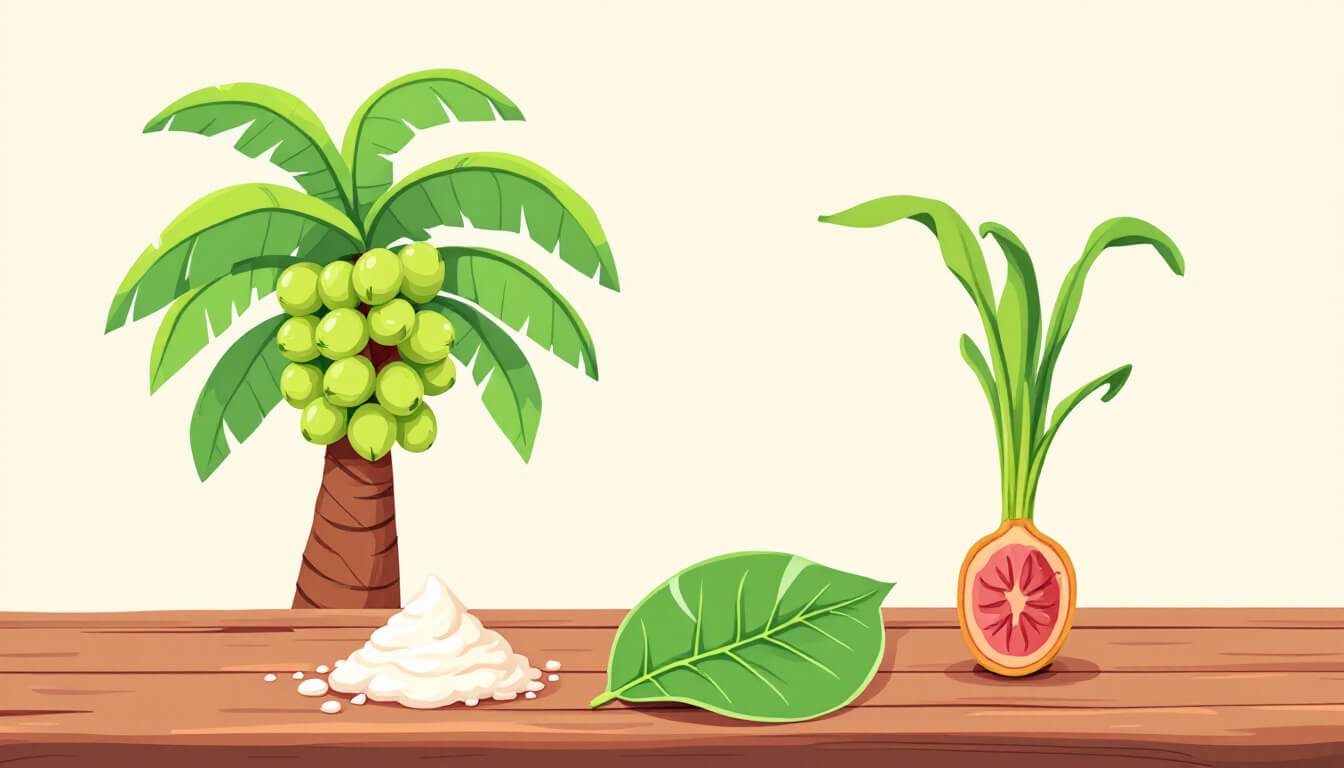
Betel nut isn’t actually a nut. It’s the seed of the areca catechu palm, a tall slender tree native to South and Southeast Asia that thrives in Taiwan’s humid southern lowlands. The fruit is roughly the size of a small egg, with a green outer husk and a streaky pink-and-white fibrous interior wrapped around the seed itself. Chewing the raw fruit alone wouldn’t do much. The magic — and the mess — comes from how it’s prepared.
A typical Taiwanese betel nut serving is a careful little package. The chewer takes one fresh nut, slits it open, and tucks a smear of slaked lime paste (calcium hydroxide, often dyed red or white) into the cut. Then the whole thing is wrapped in a glossy green piper betle leaf — a different plant entirely, related to black pepper, with a peppery bite and a slick surface. The package is popped into the side of the mouth, like chewing tobacco, and worked between cheek and gum.
The lime is the chemical trigger. It activates the alkaloids in the nut and turns saliva a vivid blood-orange red within seconds. This is why the sidewalks outside any traditional market or truck stop in Taiwan are dotted with rust-colored splatters — the spit of betel chewers, an instantly recognizable visual signature of the habit. First-time visitors often mistake it for something far more alarming. It is, in fact, just the byproduct of a centuries-old chemistry experiment happening one cheek at a time.
Three plants, one ritual: areca seed, slaked lime, betel leaf. Botanically simple. Culturally enormous.
The Stimulant Effect — Why It’s Chewed and What It Does to You

People don’t chew betel nut for fun. They chew it because it works. The alkaloid arecoline binds to the same receptors in the brain that nicotine targets, producing a mild but reliable stimulant effect — increased alertness, a slightly elevated heart rate, a warm flush across the face and chest, and the kind of focused attention that’s useful when you’ve been driving a delivery truck through mountain switchbacks for nine hours straight. Taiwanese chewers often describe it as a cross between three espressos and a small glass of beer.
The effect kicks in within about a minute and lasts roughly half an hour to forty-five minutes. That short half-life is part of why heavy chewers go through a packet of ten or twenty nuts during a long shift — it’s a stimulant you can dose continuously, with your hands free, without stopping to brew coffee or smoke a cigarette. For long-haul drivers, the appeal is obvious. So is the appeal for construction crews, factory workers on night shifts, and farmers working long stretches in the southern heat. Betel nut is the working-class stimulant of choice in Taiwan, and has been for generations.
The side effects are immediate and not subtle. The face flushes red. The mouth fills with that rust-colored saliva. Teeth and gums slowly stain a deep mahogany over years of chewing, with the inside of the lower lip often turning permanently dark. Long-term chewers develop submucous fibrosis — a tightening of the soft tissue of the mouth that makes it progressively harder to open the jaw fully — and the World Health Organization classifies betel nut as a Group 1 carcinogen, putting it in the same risk category as tobacco and asbestos. It is, in short, a stimulant that works extremely well and exacts a very real biological price.
Who Chews It — Truck Drivers, Blue-Collar Taiwan, and Indigenous Tradition

Walk into a high-rise office in Taipei’s Xinyi district and you will not find anyone chewing betel nut. Walk into a truck stop on the central cross-island highway, or a betel farm in Chiayi, or a fishing harbor in Hualien, and the picture flips completely. Betel nut has always been a working-class stimulant in Taiwan, and the demographics map almost perfectly onto certain professions: long-haul truck drivers, taxi drivers, construction workers, fishermen, farmers, dock workers, and anyone whose job demands long hours of focused physical attention. It overlaps heavily with the country’s other defining blue-collar habit — the constant hum of scooter culture — and you’ll often see a chewer and a Yamaha rider as the same person.
The deeper roots, though, are with Taiwan’s Indigenous peoples. Several of the sixteen recognized Indigenous tribes, particularly the Paiwan and Rukai in the south, have used betel nut ceremonially for centuries. It appears in courtship rituals, where a young man might offer prepared betel to a young woman’s family as a gesture of respect. It shows up in welcome ceremonies, weddings, and funerals. In tribal use, betel nut is sacred, not merely stimulating — closer in spirit to how kava is used in Polynesia than to how Red Bull is used at a desk.
When mainland Han Chinese settlers arrived in Taiwan in the seventeenth and eighteenth centuries, they adopted betel chewing from the Indigenous population and carried it into Hokkien farming communities, where it spread to the coastal working class. By the mid-twentieth century, it was a normal part of daily life across a huge slice of rural and blue-collar Taiwan. Estimates from the early 2000s suggested up to two million Taiwanese chewers, roughly one in ten adults at the peak. That number has fallen sharply in the past two decades, but among the populations who still chew, the habit is deeply embedded.
The Glass Box Phenomenon — How the Betel Nut Beauties Became the Storefront

The glass booths are the part everyone notices first. In Mandarin they’re binglang xishi — “betel nut beauties” — and they exist because betel nut is one of the most fiercely competitive products in Taiwan. The booths sell a commodity. The nut, the lime, and the leaf are the same at every stand within a ten-kilometer stretch of road. Quality varies slightly, but not enough for most drivers to taste the difference at sixty kilometers an hour. So how do you get the truck driver to choose your booth over the one a hundred meters down the highway?
The answer, starting in the late 1960s in a Taoyuan suburb called Nankan, was visibility. A booth owner named Shuangdong added bright lights and a glass front to his stand. Customers could see the product, see the staff, and — crucially — see the booth itself from a long way down the road. Sales climbed. Neighboring stands copied the model. By the 1980s, the glass-box layout was standard across the country, and the staff inside had become the differentiator. Younger women in increasingly eye-catching outfits — short skirts, neon platforms, sometimes lingerie-style tops — would be hired specifically to draw the eye of passing drivers. Some booths competed on outfit, some on personality, some on speed of service. A skilled Beauty could prep a packet of ten nuts in under thirty seconds without looking down.
The Beauties are a deeply Taiwanese phenomenon. They have no real equivalent in any other country that chews betel — not India, not Vietnam, not Papua New Guinea. The aesthetic is its own genre: fluorescent lighting, dance-pop on the booth radio, a single Beauty visible through three walls of glass, and the whole structure plopped at the edge of a highway like a roadside aquarium. International photographers — most famously the photographer Tobie Openshaw, whose decade-long documentary project introduced the booths to the English-language world — turned the Beauties into one of Taiwan’s most recognizable visual exports. The booths show up in fashion editorials, art-school theses, and travel reels. They have outlived the era they were designed for, and they outlast scrutiny because no one has invented a better way to sell an identical product to a driver who has thirty seconds to decide.
The Beauties exist on a different cultural axis from traditional Taiwanese clothing, but they share a function — a uniform that signals an industry. Just as a qipao reads as restaurant hostess and a Hakka floral print reads as countryside grandmother, the Beauty’s neon platform shoes and miniskirt read, unambiguously, as betel nut booth.
The Public-Health Pushback — Oral Cancer, Government Campaigns, and the Slow Ban-by-Attrition
Taiwan has one of the highest rates of oral cancer in the world, and betel nut is the main reason. Studies from the country’s National Health Research Institutes have linked roughly ninety percent of male oral cancer cases to betel chewing, often in combination with smoking and drinking. The combined risk for a man who chews, smokes, and drinks is more than a hundred and twenty times the risk of someone who does none of the three. These are not subtle numbers. Every Taiwanese dentist, oncologist, and Health Ministry official knows them.
The result has been one of the most patient public-health campaigns in the country’s history — patient because no Taiwanese government has ever wanted to ban betel nut outright. A direct ban would crush a multi-billion New Taiwan dollar agricultural industry, devastate hundreds of thousands of growers (mostly in Chiayi, Nantou, and Pingtung counties), and trigger a political revolt among the working class. So Taiwan went the other direction. Instead of banning the chew, the government has chipped away at the periphery — restricting where booths can be built, regulating the dress code of Beauties (most cities now require shoulders and thighs to be covered), running graphic anti-cancer ads on television, sponsoring free oral screenings at construction sites and truck depots, and steadily moving betel cultivation off mountain slopes where it accelerates erosion.
The campaigns have worked, slowly. Adult chewing rates have fallen from around ten percent in the early 2000s to roughly three percent today. The age curve has shifted hard — chewers are now overwhelmingly older men, often over fifty, and almost no one under thirty picks up the habit for the first time. Booths that once lined every kilometer of the central highway are thinning out year by year, and the ones that remain increasingly sell coffee, energy drinks, and cigarettes alongside the nut. It is a ban by attrition: no single dramatic law, just a slow generational removal of the habit from polite society.
What Foreign Visitors Should Know — Should You Try It and What Happens If You Do

If you’re traveling in Taiwan and you’re curious, the question is going to come up. The honest answer is that it’s legal, it’s everywhere, and most foreign visitors who try it once never try it again. Here’s what to expect.
You can buy a single packet at almost any rural booth for around twenty to fifty New Taiwan dollars (under two US dollars). The Beauty will hand you the prepared package wrapped in the betel leaf and gesture toward the side of your mouth. Tuck it between your cheek and gum, like a wad of tobacco. Do not bite down hard. Chew slowly. Within thirty seconds your mouth will fill with that signature red saliva. Most first-timers find this profoundly weird and immediately want to spit, which is exactly what you do — there will usually be a plastic-lined bin or a designated patch of curb nearby. Locals will be unfazed. Tourists will look horrified.
The taste is bitter, peppery from the leaf, and sharply astringent. The flush hits a minute or two later — warm cheeks, a slightly racing heart, and a clear-headed alertness that can be genuinely useful if you’ve been jet-lagged for three days. The crash, when it comes, is mild. The lingering numbness in the cheek is not. Most first-time chewers spit the wad after five or ten minutes, well short of finishing it.
If you’re going to try it, a few rules. Don’t do it on a full stomach (the lime is rough on the gut). Don’t swallow the saliva (it’s harsh and stains everything). Don’t do it more than once or twice on a trip — habituation is not the goal. And if you’re not curious, that’s a perfectly reasonable choice. The visual experience of a glass-box Beauty handing you a betel packet is the cultural artifact most visitors actually came for. The chewing part is optional.
And if you’d rather take home a different kind of Taiwan everyday-culture souvenir — something you can wear without staining your teeth red — we’ve got you covered.

Wear the Taiwan You Love
From night-market icons to quirky roadside Taiwan, our tees and merch celebrate the everyday culture that makes this island unforgettable — without the red-stained smile.
The Cultural Future — A Fading Taiwanese Habit and What’s Replacing It

The story of betel nut in Taiwan over the next twenty years is almost certainly a story of slow disappearance. Younger Taiwanese — the same generation that grew up with bubble tea, specialty coffee, and convenience stores on every corner — overwhelmingly do not chew. The habit reads as old-fashioned, blue-collar, and medically reckless in a way that contemporary urban culture finds unappealing. When younger drivers want a quick stimulant on a long shift, they reach for a canned coffee from 7-Eleven or an energy drink from FamilyMart, not a packet of nuts from a roadside booth.
The booths themselves are following the chewers into retirement. The Ministry of Health estimates that the number of active stands has fallen by more than half since 2010. Many of the remaining booths have pivoted into hybrid roles — selling cigarettes, lottery tickets, coffee, and snacks alongside the nut, more like rural convenience stops than dedicated chew shops. The Beauty profession has largely faded with them. Where there were once tens of thousands of Beauties working the highways, there are now a few thousand at most, mostly concentrated in southern Taiwan where the truck-driver demographic still holds on.
What’s replacing it is harder to name. There’s no single new stimulant taking betel nut’s exact place — Taiwan’s caffeine culture is now extraordinarily mature, and the working class drinks the same canned coffees as the office class, which itself feels like a quiet kind of cultural progress. What’s lost in the trade is something more specific to Taiwan: the unique aesthetic of the glass booth, the ritualized weirdness of a stimulant grown on a domestic palm, the sacred ceremonial use by Indigenous communities, and a working-class habit that — for all its real medical cost — bonded together generations of Taiwanese laborers in a way that a vending-machine latte never will.
Frequently Asked Questions About Betel Nut in Taiwan
Is betel nut legal in Taiwan? Yes. There has never been a national ban. Cultivation, sale, and personal use are all legal, though municipalities regulate where booths can operate and how Beauties can dress.
Is betel nut addictive? Yes. Arecoline produces both physical tolerance and psychological dependence. Heavy chewers often report difficulty stopping, with withdrawal symptoms that include irritability, fatigue, and craving.
What does betel nut taste like? Bitter, peppery from the leaf, sharply astringent from the lime, with a warm chemical flush that follows within a minute. It is an acquired taste that most non-chewers do not acquire.
Why are the booths called Beauty stands? The marketing model — young women in eye-catching outfits behind glass walls — emerged in the late 1960s as a way for booths to differentiate themselves on commodity products visible to highway drivers.
Will betel nut disappear from Taiwan? Probably not entirely, but it will become increasingly rare. The current trajectory points toward a small, aging, predominantly southern and rural chewer base by the 2040s.
Should I try it as a tourist? If you’re curious and have no medical conditions, one small packet is unlikely to harm you. Repeated use absolutely will. Most foreign visitors find one experience is enough.
Final Thoughts: A Roadside Culture in Slow Retreat
Betel nut is one of those Taiwanese artifacts that doesn’t fit neatly into any single story. It’s ancient and modern, sacred and commercial, working-class and photographed-by-art-students, deeply harmful and deeply Taiwanese all at once. The glass booths on the highway are simultaneously a public-health emergency and an aesthetic icon. The Beauties are simultaneously a labor question and a cultural export. The nut itself is simultaneously a stimulant that helped truck drivers keep the island’s logistics running for fifty years and a Group 1 carcinogen that the country is gently, finally, asking to retire.
That’s the texture of Taiwan that we love writing about — the contradictions that don’t resolve neatly, the cultural habits with one foot in the temple and one foot in the truck stop. If you’re the kind of traveler or culture nerd who wants to understand the island past the postcards, betel nut is one of the more honest entry points. It is unglamorous, complicated, and changing. Which is, in a way, the most Taiwanese thing about it.
Get the Taiwan Stories You Won’t Find in Guidebooks
Weekly culture, food, and quirky-Taiwan deep-dives delivered straight to your inbox. Plus first looks at new merch drops.

Grab a Free Taiwan Sticker!
Drop your email and we’ll send you a limited-edition Taiwan sticker — plus insider access to new merch drops and island vibes.
No spam. Unsubscribe anytime.