Aiwen Mango Season: Why Taiwan’s Sweetest Summer Lasts Just Six Weeks
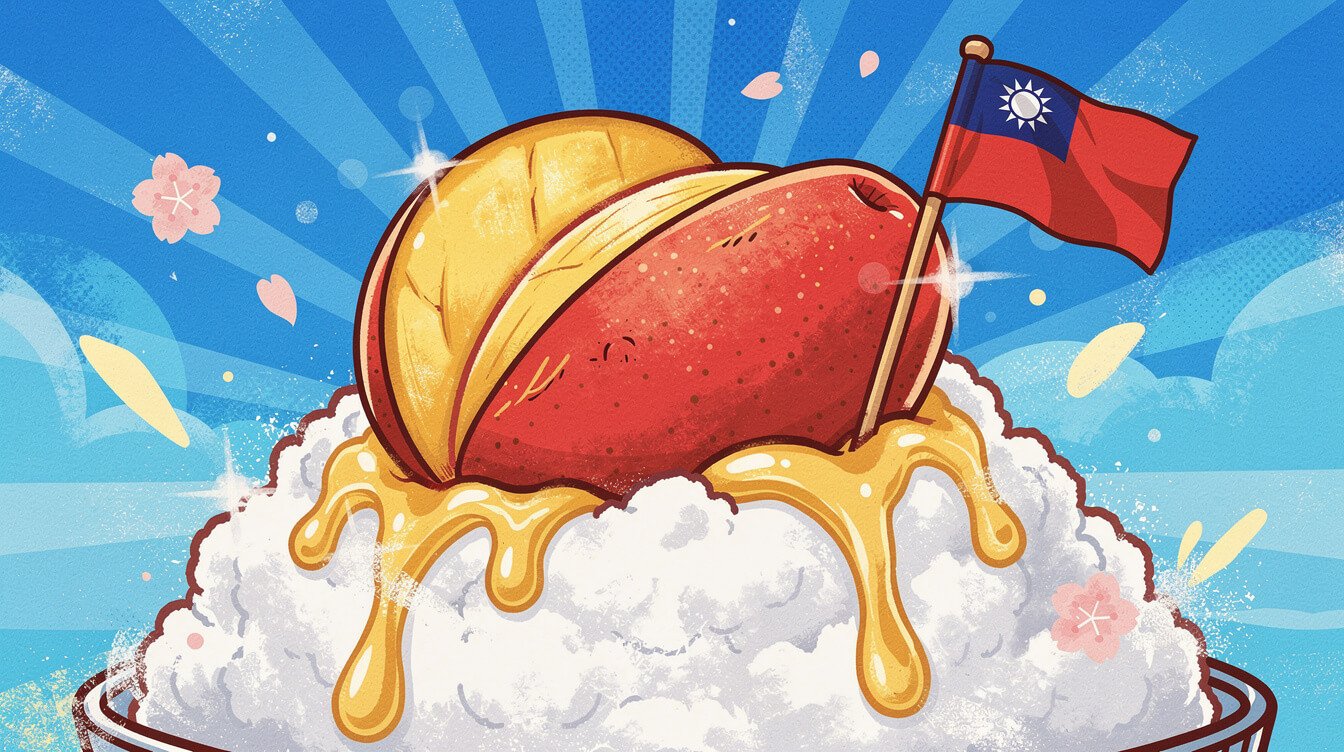
Walk into any Taiwanese market between late May and early July and you’ll spot them — pyramids of deep crimson fruit so red they look almost airbrushed. These are Aiwen mangoes (愛文芒果), and they’re the reason Taiwan’s summer doesn’t really begin until the first ones hit the stalls.
The Six-Week Window
Aiwen mangoes have one of the tightest seasonal windows of any iconic Taiwanese fruit. Peak harvest runs roughly from late May through early July — about six weeks. Miss it, and you’re waiting another twelve months for that specific combination of cold-storage-free ripeness, intense sugar, and the perfumed floral note that only sun-ripened Aiwen delivers.
It’s why locals get genuinely excited the moment Taiwan’s “Kingdom of Fruits” kicks off mango season. Boxes are couriered island-wide. Office snack tables overflow. Mango shaved ice goes from “menu item” to “religious experience.”
Did You Know? Aiwen Isn’t Originally Taiwanese
Here’s the surprise — the Aiwen (愛文) is actually a Taiwanese-Mandarin rendering of “Irwin,” a mango cultivar developed in Florida. In 1954, a US agricultural cooperation mission introduced Irwin seedlings to Yujing District (玉井) in Tainan to help diversify Taiwan’s fruit economy.
Yujing’s mineral-rich foothills, hot days, cool nights, and limestone-tinged water turned out to be a near-perfect climate match. Within a generation, “Yujing Aiwen” was already outpacing its Florida parent in sweetness and aroma. Today Yujing produces roughly two-thirds of all Taiwan-grown Aiwen, and the town’s Mango Festival (玉井芒果節) every summer is basically a six-week long block party.
How to Tell a Good One
If you’re shopping the morning markets:
- Skin color: A truly ripe Aiwen is deep red to crimson over most of the fruit, with only patches of yellow-orange. Pale or mostly-yellow Aiwen is under-ripe.
- Sound and feel: Gently squeeze — it should yield slightly, like a ripe avocado. A hard mango is for shipping, not eating today.
- Smell at the stem: The stem end should smell floral and slightly resinous, almost like jasmine. If it smells of nothing, it’ll ripen in 1–2 days on the counter.
- Weight: Heavy for its size = juicy. Light = fibrous.
The Mango Shaved Ice Ritual
Aiwen’s natural partner is 芒果刨冰 (芒果冰) — a Taiwanese summer institution. Cubes of fresh mango piled on a snowy mound of milky shaved ice, drizzled with condensed milk, and crowned with a scoop of mango sorbet. The contrast — icy, milky, intensely fruity — is the entire reason Taiwan invented the dish in the 1990s.
Taipei’s 冰怪 in the Yongkang Street area is the pilgrimage spot, but every neighborhood has its own shaved ice shop running an Aiwen special right now. It pairs naturally with another Taiwanese summer favorite — 愛玉果凍 — when you want something lighter on the same plate.
Beyond Aiwen
If you fall in love with Taiwan mangoes, the rabbit hole goes deeper. The island also grows Jin Huang (金煌, “Golden Phoenix”) — huge, golden, less floral but creamier — peaking in July; Tainung No. 1, the bright yellow heirloom; and Keitt, the green-skinned giant that closes out the season in August. There’s a full breakdown in our 台灣甜點指南.
重點總結
If you’re in Taiwan right now, go eat a mango. Today. Don’t wait for the weekend. Buy three from the next morning market, eat one over the sink, and save two for shaved ice. This is the window — and Taiwan’s six sweetest weeks of the year are already counting down.
Love Taiwan’s food culture? Browse our Taiwan-inspired tees, totes, and gifts — all designed to celebrate the island that turns a Florida mango into a national treasure.
免費領取台灣貼紙!
留下您的郵箱,我們將向您發送限量版台灣貼紙——以及搶先了解最新商品發售信息和感受海島風情的機會。.
絕不發送垃圾郵件。隨時可以取消訂閱。.