Taiwan Night Market: The Complete Guide to the 300-Market Ecosystem That Fuels an Island’s Food Culture
The Taiwan night market is not a single place — it is an ecosystem. There are over 300 of them scattered across an island roughly the size of Maryland, and no two feel exactly the same. Some sprawl beneath neon-lit archways and pull in busloads of tourists every night. Others tuck themselves into single alleys behind temples, opening only on Tuesdays and Fridays, feeding the aunties and uncles who have eaten there for forty years. Together, they form the beating heart of Taiwanese food culture — a nightly, open-air masterclass in flavor, thrift, and community.
If you have ever wondered why locals talk about night markets the way Parisians talk about cafés, this guide is for you. We are going to skip the “top 10 lists” (the internet has plenty) and instead give you the mental map: how the ecosystem is structured, how each region cooks differently, which markets are actually worth planning a trip around, what to eat once versus every night, and how to navigate the whole thing without looking like a first-timer. By the end, you will know Taiwan night market culture better than most people who have visited the island twice.
Why Taiwan Has Over 300 Night Markets: A Cultural Origin Story
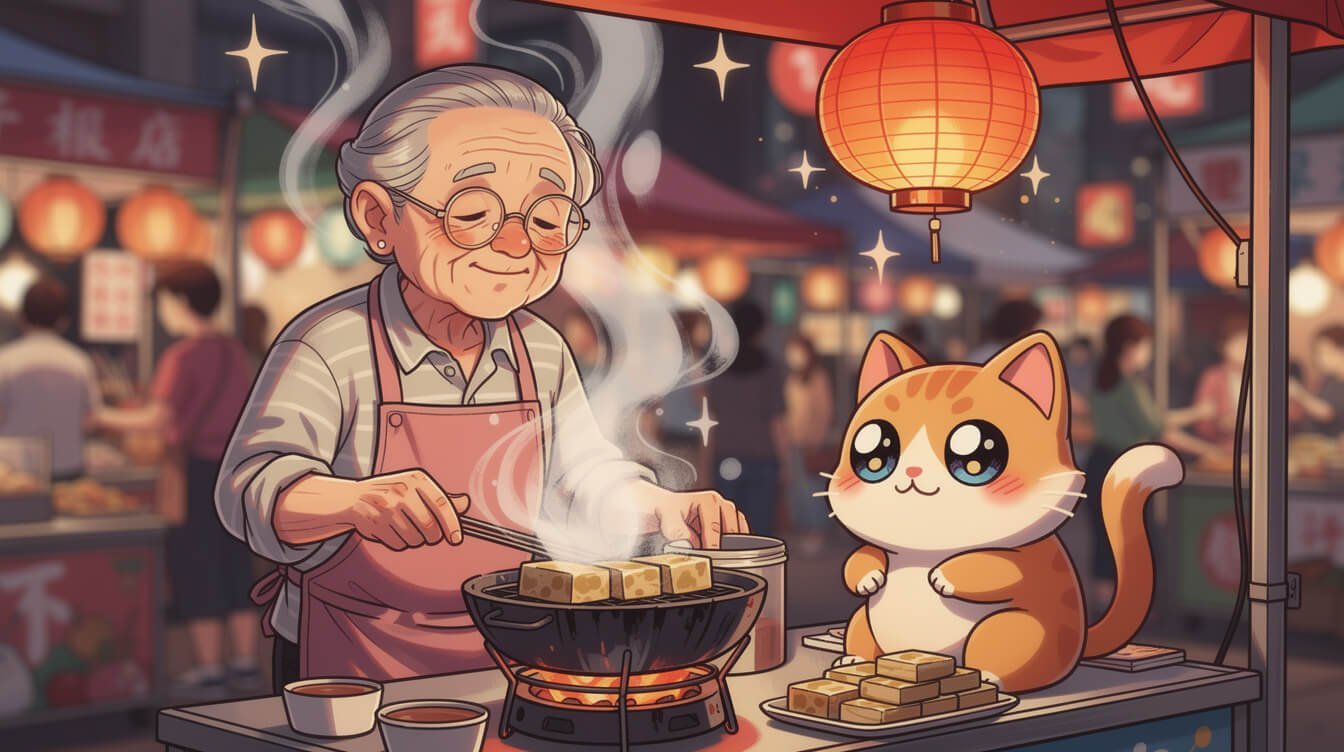
To understand why the Taiwan night market culture exploded to this scale, rewind to the mid-twentieth century. Post-war Taiwan was a subtropical island with hot, humid days that made outdoor commerce miserable until sundown. Vendors — often military families, migrants, and small farmers with a single specialty to sell — began setting up around temples in the evening. Temples already drew crowds. Vendors followed the crowds. The unspoken bargain was simple: bring your best dish, keep the price low enough for a construction worker to afford, and if the neighborhood likes you, come back tomorrow.
That temple-adjacent origin is why so many of Taiwan’s biggest markets still cluster around religious sites. Raohe Street orbits Ciyou Temple. Nanjichang grew around a wartime airfield chapel. Even the modern megamarkets like Shilin were seeded by generations of vendors who first camped outside a shrine. The night market is the secular twin of Taiwanese temple culture — same crowd, same neighborhood, same accidentally sacred sense that eating together is what makes a community real.
The other force was economic. Taiwan’s post-war “economic miracle” made everyone middle class fast, but it also created relentless work weeks. Families ate dinner out because both parents worked late. Kids ate at night markets because school ran until seven. Grandparents ran stalls because retirement was optional. The whole ecosystem was propped up by a working-class rhythm that never really went away, even after Taiwan became one of the wealthiest societies in Asia. That is the piece foreigners often miss: the Taiwan night market is not a nostalgic tourist attraction that survived by luck. It is still a functional part of how Taiwanese people actually live.
Government support helped, too. In the 1980s and 90s, the Tourism Bureau began formally recognizing markets, giving them signage, sanitation ratings, and Chinese-English maps at the entrance. That is why you will see the same official plaque design at Shilin, Fengjia, and Liuhe — a shared visual grammar that says “you are inside a legitimate cultural institution, not a random cluster of food carts.” For a broader lens on how food and identity connect, our Taiwan culture guide traces the same threads through festivals, art, and daily life.
The Three Types of Taiwan Night Market (And Why It Matters)
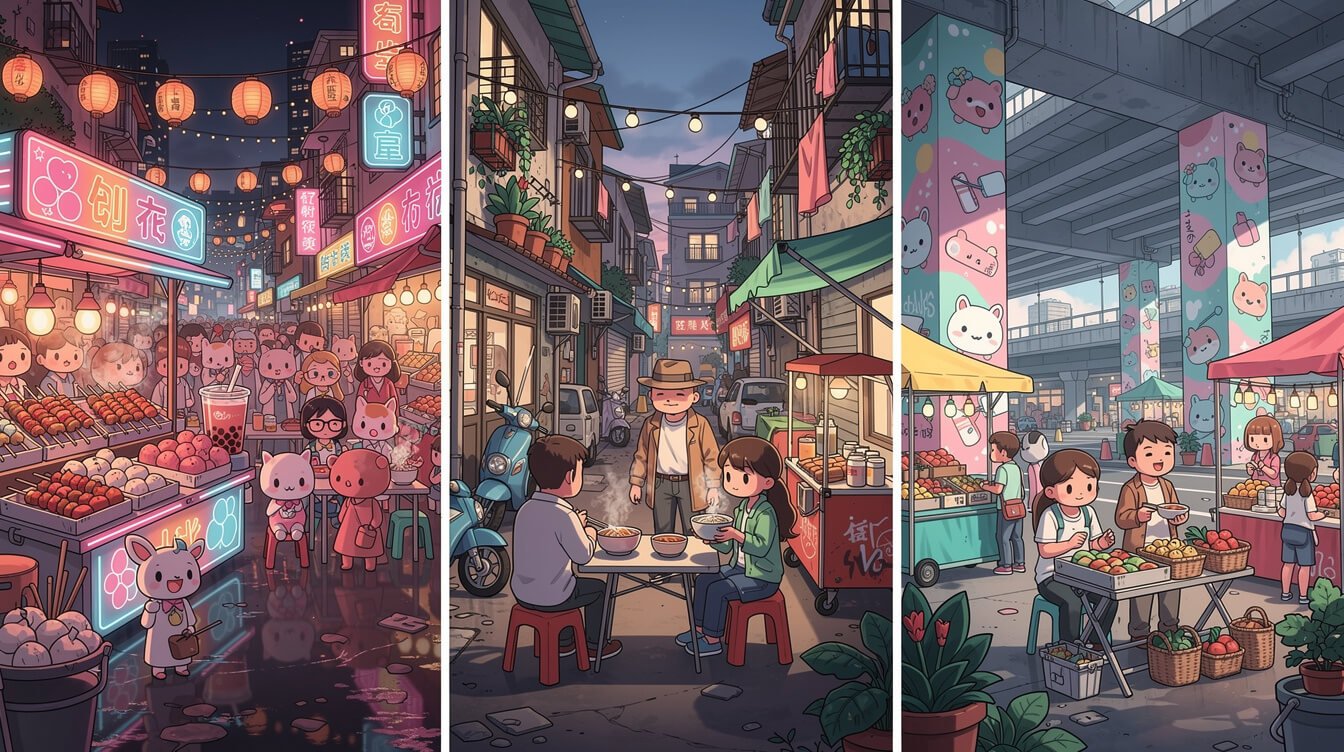
Not every Taiwan night market is trying to do the same thing. Locals implicitly sort them into three categories, and once you know the shape of each, you can pick the right one for your mood, your budget, and your appetite.
1. Tourist Megamarkets (guanguang yeshi)
These are the ones the guidebooks list first: Shilin in Taipei, Fengjia in Taichung, Liuhe in Kaohsiung. They are permanent, sprawling, and they run seven nights a week. Signage is bilingual. Prices are 20-40% higher than a local market. Vendors accept EasyCard and often speak enough English to sell you a fried squid. The crowds are dense enough on a Saturday that you may not move faster than a shuffle. The upside is variety — you can genuinely eat your way through a couple of hundred stalls in one visit — and the theatrical energy of thousands of humans eating in a single glowing corridor. The downside is that some of the food is engineered for tourists, not tastebuds. Great once. Not necessarily worth a second visit unless you have a specific stall you love.
2. Neighborhood Markets (shequ yeshi)
These are the ones locals actually eat at. Raohe in Taipei, Ruifeng in Kaohsiung, Miaokou in Keelung, Zhongxiao in Chiayi. They still get tourists, but the pace is slower, the prices are honest, and the food is what the neighborhood grandmothers grew up on. If you want to understand how a Taiwan night market actually works — the rhythm of a stall passing from father to son, the way the noodle vendor knows regulars by their orders — this is where you find it. Neighborhood markets are open most nights but often go quiet on Mondays.
3. Rotating Weekly Markets (liudong yeshi)
The most Taiwanese thing on the list, and almost nobody outside the island knows they exist. Rotating markets pack up their entire operation — grills, tarps, plastic stools, everything — and drive to a different township each night of the week. Monday might be a parking lot in Yonghe. Wednesday, a schoolyard in Sanchong. Friday, an empty field near a temple in Taoyuan. The same 40 vendors travel together like a mobile village. Prices are the cheapest of any Taiwan night market format, the food is often the most regional, and the vibe is more “traveling carnival” than “polished tourist destination.” Ask any local aunt in a residential neighborhood which night the yeshi comes to her street. Follow her instructions.
Knowing these three types matters because they answer different questions. First-time visitor with one free night? Go to a megamarket. Coming back to Taiwan for the tenth time? Chase down a rotating weekly and eat like a local. Living in Taipei for a month? Adopt a neighborhood market and become a regular.
Regional Night Market Styles: North, Central, South, East
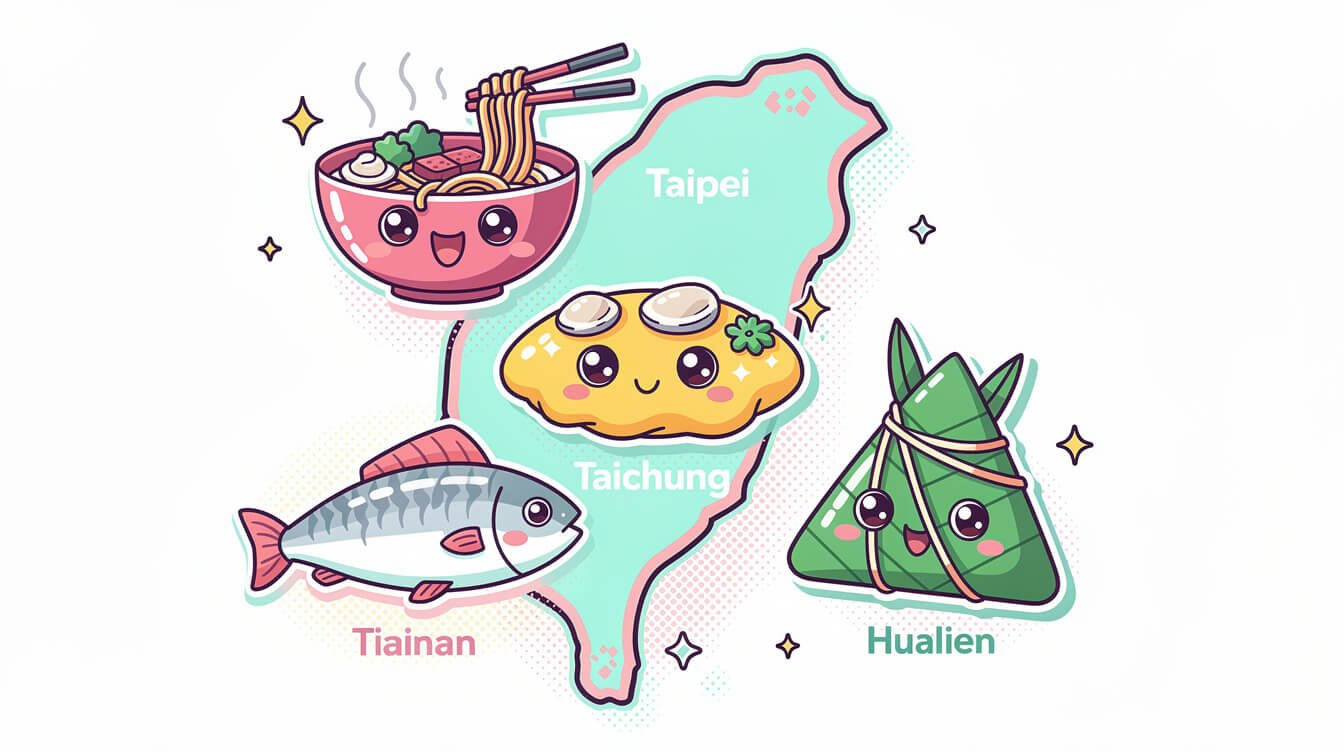
One of the most underrated facts about Taiwanese food is that the island is small but its regional cuisine variance is enormous. The same “beef noodle soup” tastes different in Taipei than it does in Tainan. That regionality plays out at the Taiwan night market level, too — every corner of the island has its own signature dishes, price points, and even the physical layout of the stalls tends to feel distinct.
North (Taipei, Keelung, Taoyuan)
The north is where night market culture is at its most refined and its most commercialized. Portions are smaller, prices are higher, and the food skews toward Fujianese and Japanese-influenced dishes: pepper buns (hujiao bing) blistered in tandoors, pork intestine noodles served in tiny bowls, and Japanese-style okonomiyaki adapted with Taiwanese fillings. Keelung’s Miaokou market is a special case — a covered market that specializes in seafood pulled off the boats that morning. If you love oyster omelets, this is the promised land. The northern night market experience is closest to what most tourists have in mind when they picture Taiwan.
Central (Taichung, Nantou, Changhua)
The center is where the volume gets loud. Taichung is home to Fengjia — the single busiest Taiwan night market in the country, with over 100,000 visitors on a peak weekend. Central Taiwan is student territory (four major universities cluster around Fengjia alone), so the food skews cheap, filling, and Instagram-friendly. This is the birthplace of bubble tea and the epicenter of endless dessert experimentation — deep-fried mochi, cheese-topped shaved ice, giant fried chicken cutlets the size of a face. For a deeper dive into the drink that started it all, see our Taiwan bubble tea guide.
South (Tainan, Kaohsiung, Pingtung)
The south is the historic culinary capital of Taiwan, and it shows. Tainan was the island’s original capital city for two centuries, and its food scene evolved slower, deeper, and with a stubborn devotion to sweetness that will surprise a first-time visitor. Danzai noodles, milkfish soup, coffin bread, and shrimp rolls all come from the south. Kaohsiung’s Liuhe and Ruifeng markets are enormous but still feel less touristy than Fengjia, and prices drop noticeably as soon as you cross south of Taichung. If you are a serious eater, the south rewards you.
East (Hualien, Taitung, Yilan)
The east coast is the sleeper region. Only about ten percent of Taiwan’s population lives there, but the food culture is uniquely influenced by indigenous Amis and Truku traditions, and by the aboriginal wild-caught ingredients that show up nowhere else. Dongdamen Night Market in Hualien has a whole section devoted to indigenous fusion cooking — think grilled wild boar, sticky rice cooked in bamboo, and millet wine. The east’s Taiwan night market experience is less about scale and more about singular, hard-to-find flavors.
The 10 Iconic Taiwan Night Markets Worth Planning Around
Most “best of” lists are recycled from the same tourism brochure. This one is not. These are the ten markets we would actually re-visit — ranked by vibe, food quality, and how much the trip is worth for the eating you get.
- Raohe Street Night Market, Taipei. Compact, elegant, walkable end-to-end. The pepper buns at the entrance are worth the queue. Best introduction to a Taiwan night market for a first-timer. Nearest MRT: Songshan (Green Line).
- Shilin Night Market, Taipei. The most famous, the most touristy, the biggest. Overwhelming on a Saturday, but the Shilin Big Sausage in Small Sausage is a bucket-list dish. Nearest MRT: Jiantan.
- Ningxia Night Market, Taipei. The old-school heart of Taipei. Small, single-street, entirely food-focused. If you only visit one Taipei market, and you care about eating better than photographing, choose this one.
- Fengjia Night Market, Taichung. The busiest market in Taiwan. Enormous, chaotic, cheap. Comes alive after 9 PM. Bring stretchy pants.
- Liuhe Night Market, Kaohsiung. Southern classic. Seafood is fresher here than anything you will get in Taipei. Best for oyster omelets and papaya milk.
- Ruifeng Night Market, Kaohsiung. The local counterpart to touristy Liuhe. Bigger, cheaper, and where Kaohsiung’s students actually eat.
- Miaokou Night Market, Keelung. Covered, permanent, seafood-forward. Every stall has a numbered sign. Come hungry, work through the numbers.
- Kenting Night Market, Pingtung. Beachside, seasonal, and the only major market on the southern tip. Weekends only in peak season. Beach cocktail and grilled squid energy.
- Dongdamen Night Market, Hualien. The east coast’s only real market, but it doubles as the cultural showcase for indigenous Taiwanese cuisine.
- Luodong Night Market, Yilan. Compact and criminally underrated. Yilan-style scallion pancake, mochi from the local specialty shops, and a river of tourists on weekends. Skip the crowds by going Tuesday.
If you are building an itinerary, planning your Taipei nights around Raohe, Ningxia, and Shilin gives you a full spectrum. For district-by-district navigation and the MRT lines that link the northern markets, our Taipei map guide is the companion reference.
What to Eat at a Taiwan Night Market: The Must-Try, Try-Once, and Skip Lists
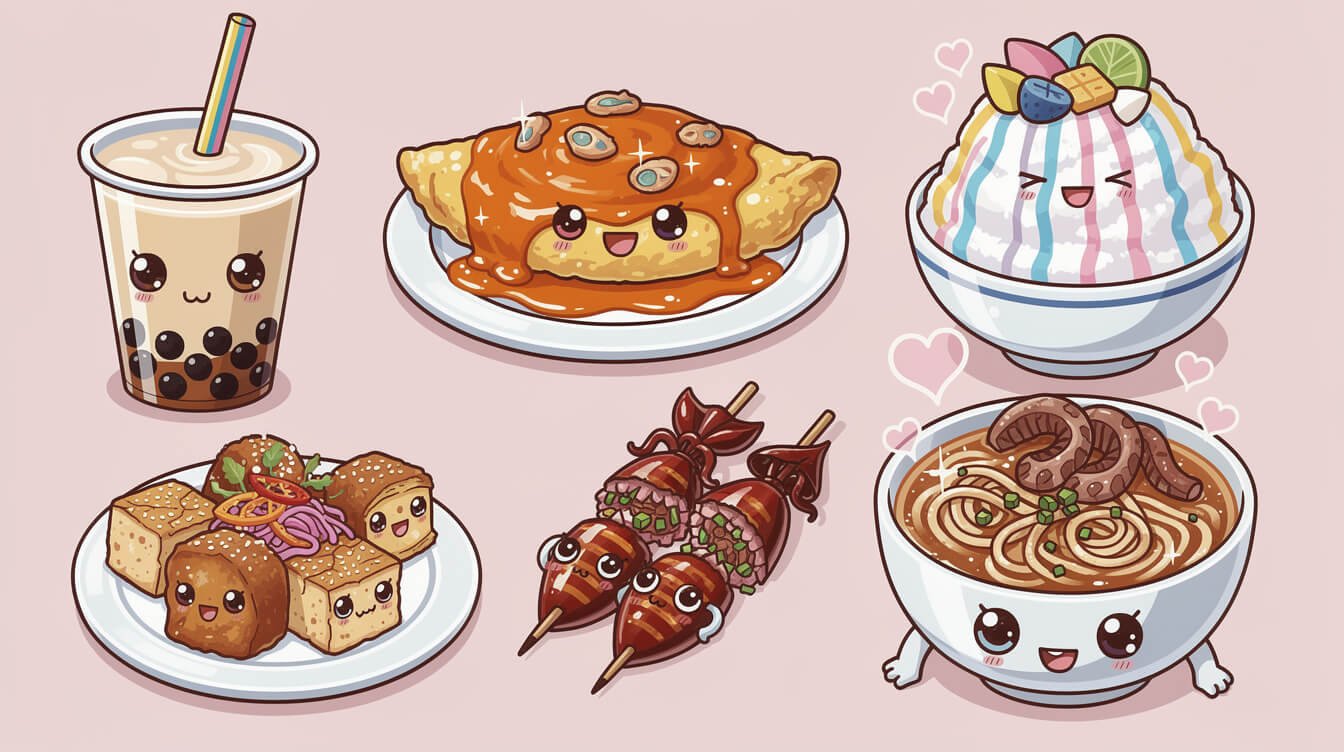
The single biggest mistake first-time visitors make is trying to eat one of everything. You cannot. A serious Taiwan night market run is more like a wine tasting — you graze small, you share, and you save room for what really matters. Here is our honest triage.
Must-Try (do not leave Taiwan without eating these)
- Oyster omelet (o-a-jian). Sweet-tangy sauce, crisp-chewy sweet potato starch, tiny plump oysters. The signature Taiwanese night market dish. Best versions at Keelung Miaokou or Ningxia.
- Pepper bun (hujiao bing). Fresh dough slapped inside a tandoor oven, filled with peppery pork and scallions. Raohe’s original stall (at the temple end) is legendary — expect a 20-minute queue.
- Beef noodle soup (niu rou mian). Not exclusive to night markets, but the night market bowl is often the best on a budget. Our Taiwan beef noodle soup guide covers the varieties in detail.
- Stinky tofu (chou doufu). Yes, really. The good stuff is crispy outside, custardy inside, and served with pickled cabbage. Deep-fried is easier for beginners; braised is for advanced players. See our stinky tofu guide if you need convincing.
- Bubble tea (zhenzhu naicha). Get it fresh, get it hot occasionally, and try one from a small vendor rather than a chain. Taichung markets are the birthplace.
- Shaved ice with mango (mangguo bing). Only in summer. Skip in winter — the vendors change to peanut and taro toppings, which are also great but less iconic.
Try-Once (memorable, but not for every night)
- Coffin bread (guancai ban). A hollowed toast box filled with creamy chowder. Charmingly weird. Best in Tainan.
- Big sausage in small sausage (da chang bao xiao chang). A pork sausage wrapped inside a sticky rice sausage, served like a hot dog. Shilin’s iconic dish.
- Grilled squid on a stick (kao you yu). Look for vendors with a live queue and freshly caught squid. Coastal markets do this best.
- Deep-fried mochi (zha mashu). Crispy outside, molten inside, dusted with peanut powder. Central Taiwan specialty.
- Cheese-topped potato tornado. An Instagram-era invention. Fun once, and yes, you should film it.
Skip (or at least deprioritize)
- Anything sold to only tourists at three times the price. The Turkish ice cream vendor doing the tossing trick, the six-foot fried chicken cutlet photo op, the neon-cheese sushi. Fine for content. Not why you came.
- Prepackaged pineapple cake at market prices. Buy pineapple cake at Chia Te or SunnyHills, not from a night market stall.
- Bar food on a stick that has been sitting under a heat lamp since 6 PM. Look for stalls where cooking is happening in front of you.
If you want a wearable souvenir of your favorite dish (yes, we make one for the stinky tofu diehards), our Taiwan Merch shop has a curated collection of night-market-themed apparel, drinkware, and stickers — designed by artists who grew up eating this food.
Wear Your Night Market Love
From boba tees to stinky tofu stickers, our collection celebrates Taiwan’s street food culture in wearable, giftable form. Designed with the same warmth as a proper night-market run.
Insider Tips: Timing, Etiquette, Money & Common Questions
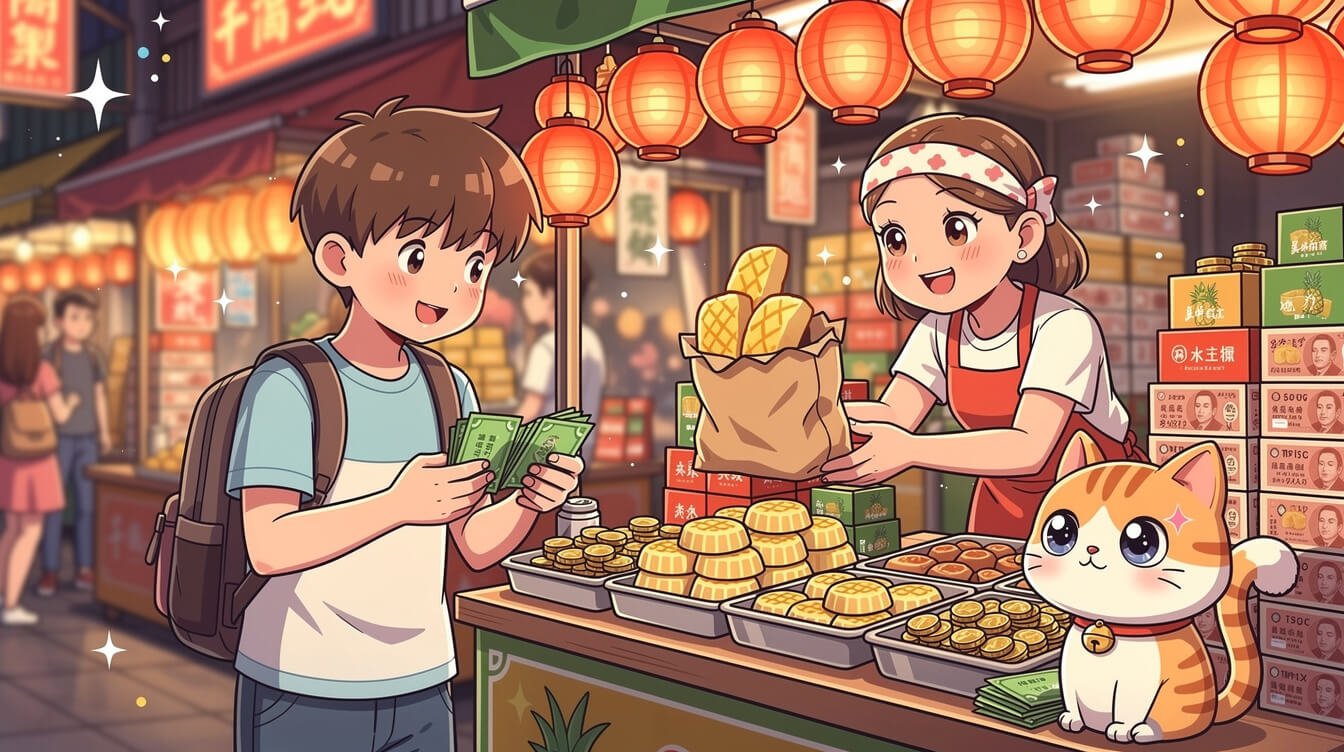
The last thing standing between you and a truly good Taiwan night market run is logistics. These are the details that separate someone who has visited from someone who knows the ropes.
When to go
Most Taiwan night markets open at 5 PM and hit peak from 7 to 10 PM. Vendors start closing after 11 PM. If you want the good food but not the crowds, arrive at 5:30 or 6 PM — half the stalls are already open, prices are the same, and the queue for the pepper bun is 10 minutes, not 40. Locals eat late. Tourists eat early. Play whichever side you prefer.
Cash is king
Bring cash. Small bills. NT$100 and NT$500 notes are ideal. Most stalls do not take credit cards, and only the big markets accept EasyCard. There are 7-Eleven ATMs everywhere in Taiwan that dispense cash on foreign debit cards without drama.
Etiquette
Point to what you want if your Mandarin is rusty. Do not haggle — prices are fixed and honest. Eat standing up at the stall you bought from, not while walking to the next one (this is considered rude by older vendors). Trash cans are rare on purpose; carry your wrappers to the next 7-Eleven if the stall does not have one. Tipping is not expected and can be mildly awkward.
Dietary considerations
Vegetarians will have some options but need to work harder. Look for stalls advertising 素食 (sushi, “vegetarian”). Buddhist stalls are often onions-and-garlic-free. Gluten-free is difficult — soy sauce is everywhere. Halal is limited to a small number of stalls near mosques, mostly in Taipei’s Da’an district.
Frequently asked questions
Are Taiwan night markets safe to eat at? Extremely. Taiwan has one of the strictest street-food sanitation regimes in Asia. Government-registered markets carry a hygiene rating plaque at the entrance. Stick to stalls where cooking is happening in front of you and you will be fine.
Do vendors speak English? At megamarkets like Shilin and Fengjia, often yes. At neighborhood and rotating markets, rarely. Point, smile, and hold up fingers for how many you want. That works everywhere on the island.
Which Taiwan night market is best for a first-time visitor? Raohe. It is compact, walkable, has the pepper bun and stinky tofu icons, and gets you a full Taiwan night market experience in about 90 minutes.
What is the biggest Taiwan night market? Fengjia in Taichung by foot traffic, Shilin in Taipei by physical footprint. Both are worth visiting once for the sheer scale.
Are Taiwan night markets kid-friendly? Yes. Kids come with parents, grandparents, and school friends. Most markets have carnival-style games and toy stalls in addition to food. Just watch for the deep-fry queues at busy times.
When are they closed? Rare, but check ahead of Lunar New Year (many close for 3-5 days) and typhoon warnings (safety closures). Monday is the quietest night at most neighborhood markets.
Final Thoughts: The Night Market Is Taiwan
If you spend enough time in Taiwan, you stop thinking of the night market as a place you go and start thinking of it as a time of day. The evening breeze changes, the lanterns come on, and half the island quietly agrees that it is time to eat outside with strangers. That is not a tourist attraction. That is a civilization telling you how it likes to live.
The 300 markets are not there because Taiwan is trying to be quaint. They are there because they still work — economically, socially, and culinarily — better than any dining-industrial complex anywhere else on earth. The best move a traveler can make is to stop treating them like a checklist and start treating them like a bar. Pick your local. Learn the vendors. Become a regular for one week. You will understand more about Taiwanese culture from that than from any museum.
See you at the pepper bun queue.
Get Weekly Taiwan Stories in Your Inbox
Cultural deep-dives, artisan spotlights, night-market finds, and new merch drops — one email a week from Taiwan Merch. Written by humans who love the island.
Grab a Free Taiwan Sticker!
Drop your email and we’ll send you a limited-edition Taiwan sticker — plus insider access to new merch drops and island vibes.
No spam. Unsubscribe anytime.