Xinyi District, Taipei: Where Glass Skyscrapers Hide a Military Village’s Cold War Memory
Most guides to Xinyi Taipei hand you a checklist: Taipei 101, Din Tai Fung, a shopping mall or seven, maybe a hiking trail if they’re feeling adventurous. Then they call it a day. But if you actually walk Xinyi, from the embassy blocks near the World Trade Center to the low-slung houses of the 44 South Military Village, something strange happens. The district refuses to hold together. It’s not one place. It’s three, stacked on top of each other, and the whole point of visiting is to see where the seams show.
This isn’t the kind of thing you notice on a fifteen-stop food-and-shopping tour. But once you see it, you can’t unsee it. Xinyi is the district where Taiwan’s Cold War memory sits fifty meters from a Bellavita boutique, where a Japanese-era tobacco factory is now a design incubator, and where the tallest skyscraper in Asia (for a minute there) throws its shadow over a preserved veterans’ village that almost got bulldozed for another mall. This guide is for the traveler who wants to actually understand what they’re looking at.

Xinyi Is Three Taipeis Stacked
Let’s start with the map. Xinyi District (信義區) sits on the eastern side of central Taipei, bordered roughly by Keelung Road, Xinhai Road, and the base of the Four Beasts Mountain range. On paper it’s about eleven square kilometers, forty-one villages, and something like 210,000 residents. In practice, walk it and you’ll pass through three completely different Taiwans, each with a distinct architectural fingerprint and a distinct historical alibi.
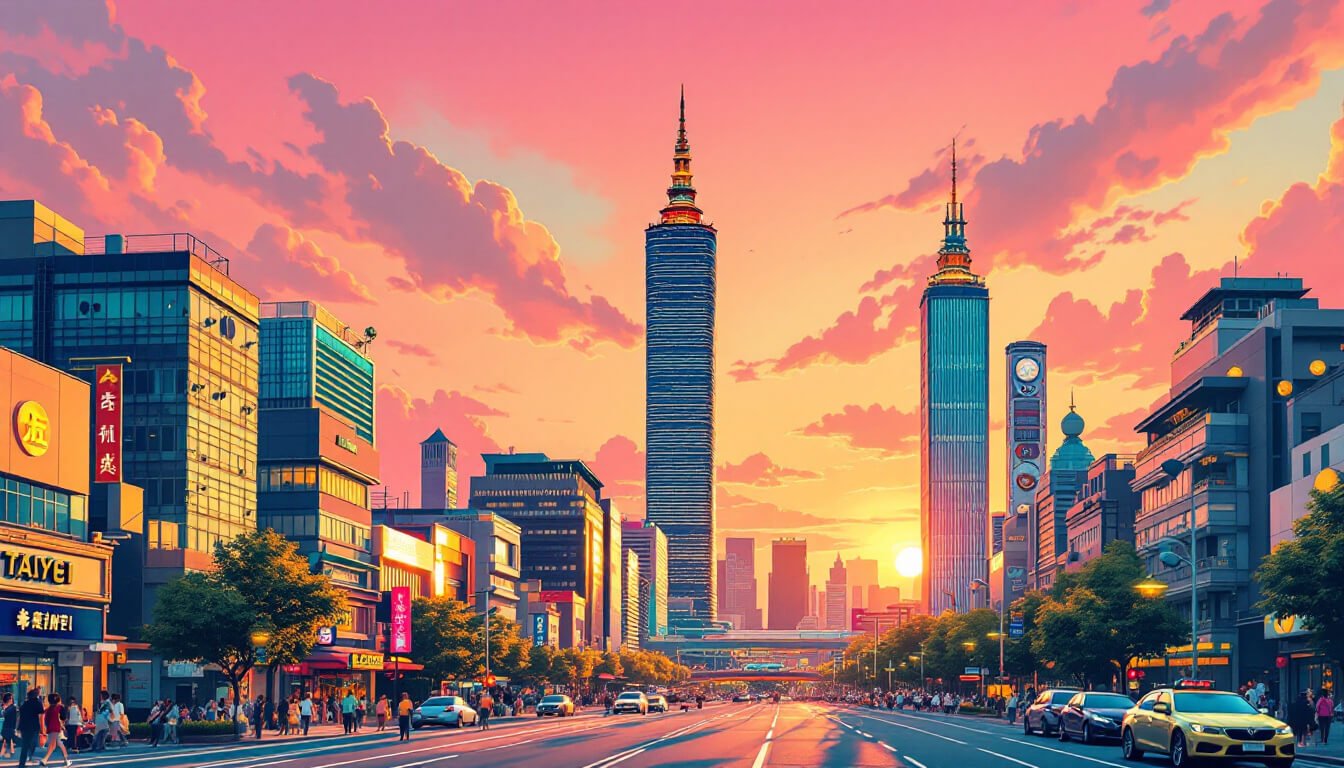
The top layer is the one every guidebook covers: the 21st-century financial district. This is Taipei 101, Xiangti Avenue Plaza, the row of luxury malls, the embassy quarter, the mirror-glass office towers where semiconductor money and finance jobs cluster. It’s the newest layer, mostly built after 1990 as part of a deliberate urban-planning push to give Taipei a downtown that could compete with Hong Kong and Singapore. Come here in the evening and it feels like every East Asian financial district ever, with a Taiwanese accent.
The middle layer is Cold War Taiwan. When the Kuomintang retreated from mainland China in 1949, they brought roughly two million soldiers, civil servants, and families with them. To house the military, the government built juancun (眷村) — dependents’ villages — clustered on the edges of major cities. Xinyi got several. Most were torn down as land prices exploded in the 1990s and 2000s. One survived: 44 South Village. It sits five minutes from Taipei 101 and it’s the reason Xinyi has a memory.
The bottom layer is the oldest and easiest to miss. Before the KMT arrived, before the skyscrapers, this area was fields, small farms, and a scattered Japanese-colonial industrial footprint. The Japanese ran a massive tobacco factory here — Songshan Tobacco Factory, opened in 1937 — which produced cigarettes for the empire until Taiwan’s tobacco monopoly was privatized in the 1990s. The buildings are now Songshan Cultural and Creative Park, one of Taipei’s best-preserved chunks of pre-war architecture. If you look at the arched brick doorways and think “this doesn’t feel Taiwanese,” you’re right — you’re standing in a piece of the Showa era.
These three layers don’t blend. They collide. Which is exactly what makes Xinyi worth walking through slowly instead of ticking off in an afternoon.
The Skyscraper Layer: Taipei 101 and the Luxury Sub-District
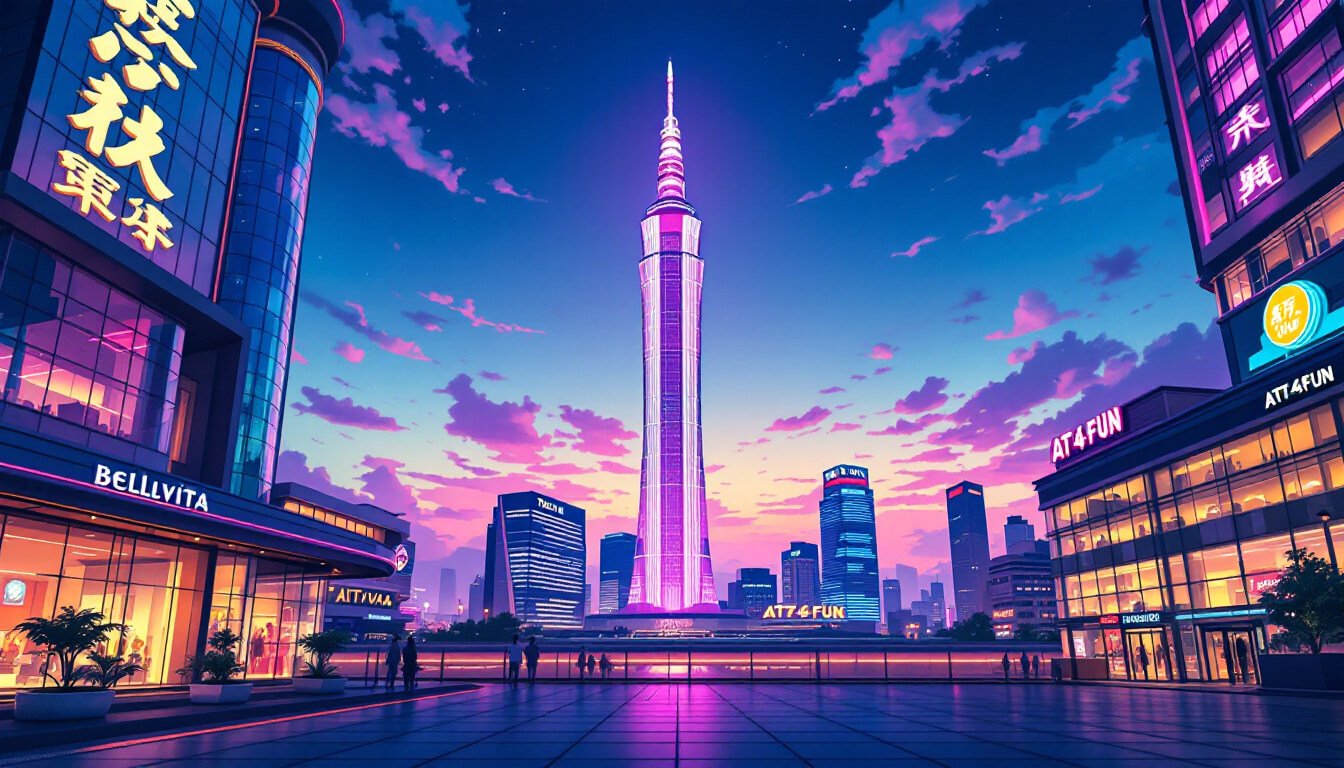
You already know Taipei 101. It was the tallest building in the world from 2004 to 2010, until Burj Khalifa took the crown, and at 508 meters it’s still an insane thing to stand under. The tuned mass damper on floors 87-92 — that giant 660-ton gold ball you can visit — is the largest of its kind in the world and it swings visibly during typhoons. The observation deck on floor 89 is worth the elevator ride if only because the elevators themselves used to hold the world speed record (1010 meters per minute).
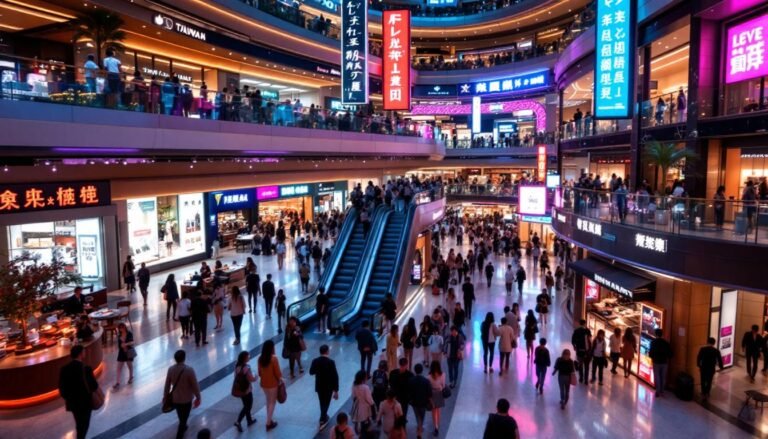
But Taipei 101 isn’t really the point. The point is the shopping-mall ecosystem it anchors, which is the closest thing Taiwan has to a proper luxury district. Bellavita 寶麗廣塲 across the street is Taiwan’s flagship for European luxury houses. ATT 4 FUN is the young-professional end of the scale, all cosmetics counters and rooftop bars. Shin Kong Mitsukoshi runs several connected buildings that get labeled A1 through A11, and if you’re the kind of shopper who wants Japanese department-store precision, this is your Tuesday afternoon. Breeze Xinyi and Dream Plaza fill in the rest.
What’s easy to miss: this whole sub-district was built on land that used to be a US military installation. Camp Coyote and its surroundings occupied a chunk of what is now the Xinyi Planning District until the 1970s. When the US pulled out and the Taiwan Miracle economy started buying every meter of dirt it could find, the government drew straight lines on the map and invited developers to build. The rigid grid of Xinyi — noticeably grid-like compared to the tangled alleys of Wanhua or Datong — is the ghost of that planning exercise.
The embassy quarter, tucked behind the malls, is where you’ll find the World Trade Center, the Taipei International Convention Center, and a cluster of consular buildings for the countries that officially maintain relations with Taiwan (and the “trade offices” for the countries that don’t). The Grand Hyatt sits at the corner. If you want a rooftop bar with a Taipei 101 view, book Frank Taipei on the 17th floor of the Le Meridien.
44 South Military Village: The Cold War Memory Preserved in Concrete
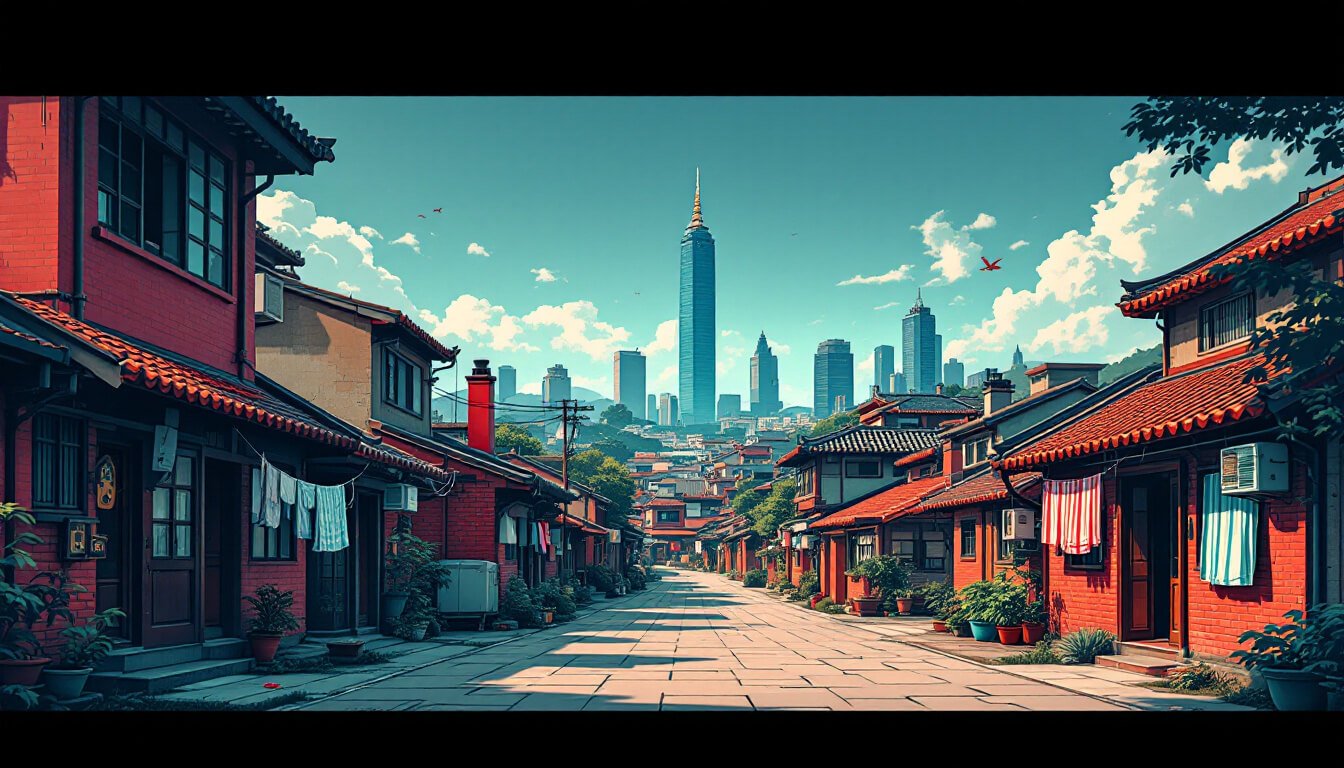
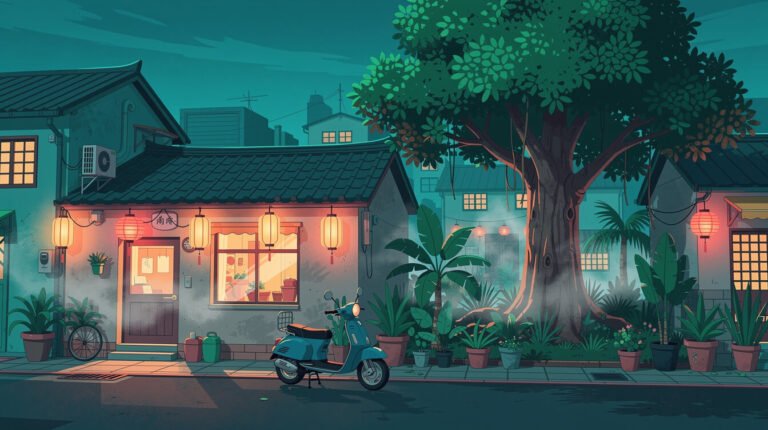
Walk five minutes south from Taipei 101 and you’ll find yourself standing in front of what looks like a completely different city. Low, one-story houses with sloping tiled roofs. Concrete walls painted in that particular shade of pale yellow that Taiwanese public housing wore for forty years. Narrow alleys where you can smell dampness in the walls. This is 四四南村 (Sìsì Nán Cūn) — 44 South Village — and it’s the closest thing Taipei has to a preserved piece of the KMT retreat.
The village was built in 1948 to house workers and their families from the 44th Arsenal, a KMT ordnance factory that had relocated from mainland China. When the KMT lost the civil war a year later, those workers and soldiers weren’t going home. So the village stayed. Roughly 6,000 people lived here at the peak, in about a thousand tiny units, each family carving out four or five square meters with plywood partitions.
Most juancun around Taiwan got demolished as land values rose and the original residents aged out. 44 South almost went the same way. In 1999 the residents were relocated and the demolition orders came through. What saved it was a coalition of local historians, former residents, and the Taipei city government under Ma Ying-jeou, who was mayor at the time. Four of the eight barracks-style buildings were preserved. The other four became a park. What you see today opened as a “cultural park” in 2003.
The permanent exhibition inside Barrack A walks you through what a juancun household looked like — the shared kitchens, the folding cots, the propaganda posters, the ration-book economy. There’s a preserved family unit you can walk into. It’s smaller than a Xinyi condo bathroom. On the weekends there’s often a Simple Market pop-up with local designers and food vendors filling the courtyard, which creates one of the most photographable juxtapositions in Taipei: hand-thrown ceramics on folding tables with Taipei 101 rising over the tiled roofs behind you.
If Xinyi is going to hit you in the chest, this is where it happens. Skyscrapers a coin toss away, and here’s a village that housed refugees from a war that Taiwan’s official history still argues about. If you want to keep the mood going after you leave, our guide to Taipei’s districts and hidden gems covers three other neighborhoods where the KMT-era layer is still legible.
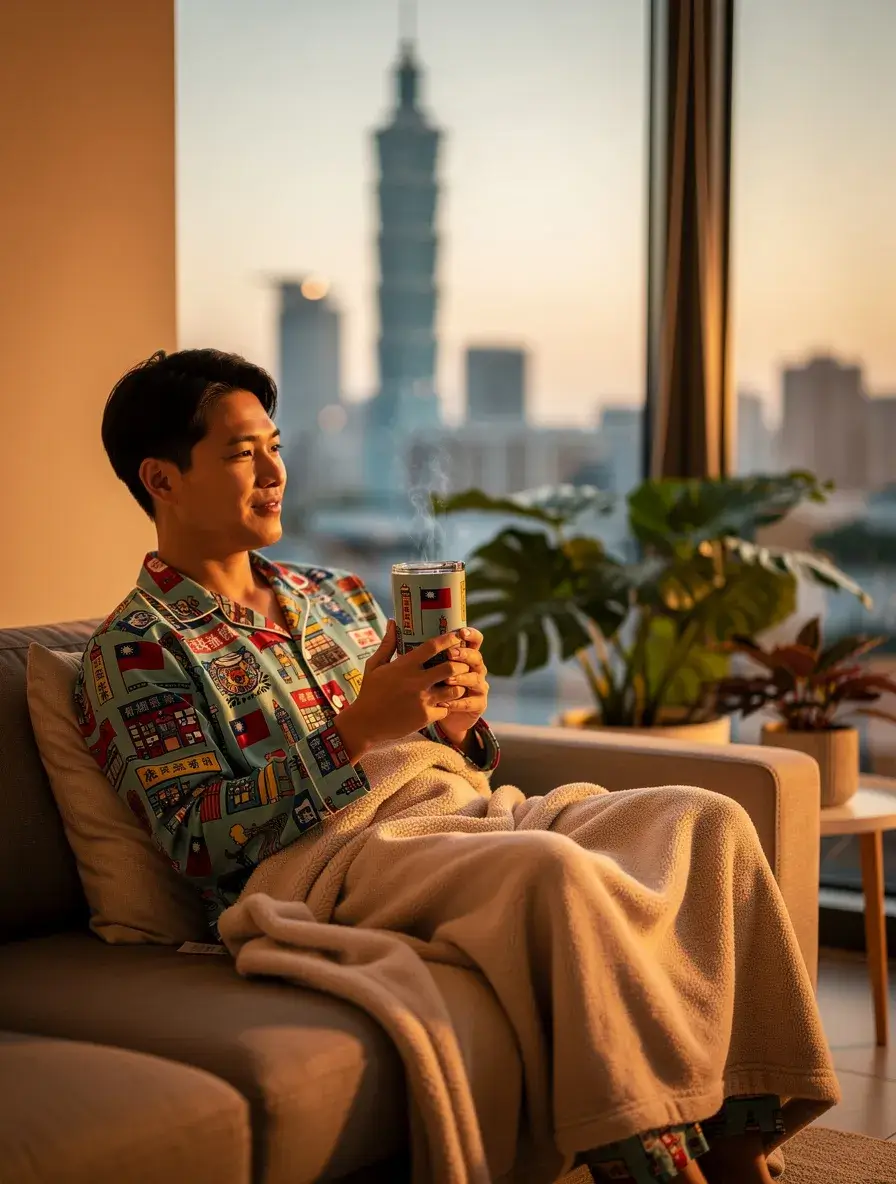
Wearable Taiwan pride pairs well with a walk through a place like this — the Taiwan Merch collection was built for exactly the kind of traveler who notices what everyone else walks past.
Songshan Cultural Park: A Japanese Tobacco Factory Reborn
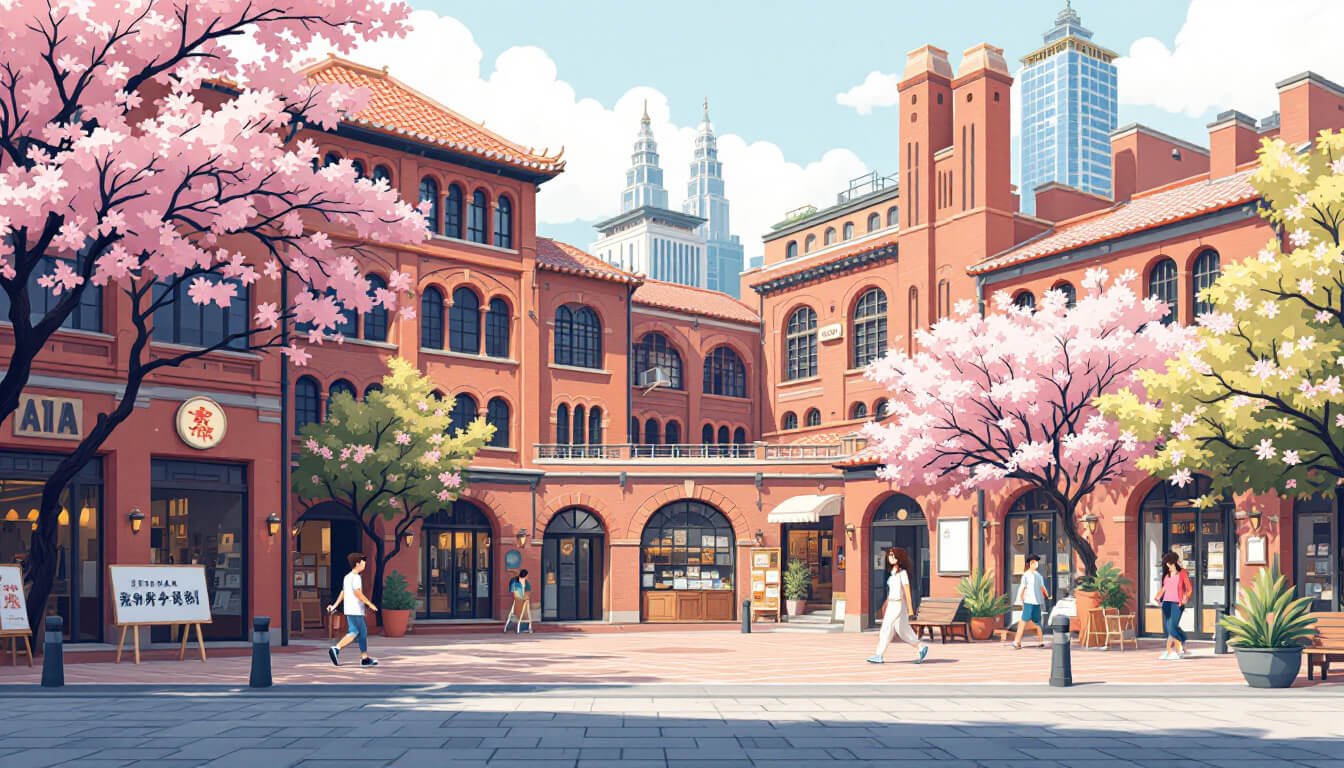
On the northern edge of Xinyi, past the Sun Yat-Sen Memorial Hall, sits another accidental time machine. Songshan Cultural and Creative Park (松山文創園區) is a 6.6-hectare campus of red-brick and reinforced-concrete buildings arranged around a central plaza, with a small ecological pond at the back. It opened as Songshan Tobacco Factory in 1937 under the Japanese colonial government. It was, at the time, the most modern industrial facility in Taiwan.
What makes it worth an hour of your afternoon isn’t nostalgia for cigarettes. It’s the architecture. Everything here was designed in a style Japanese architects were calling “modern industrial functionalism” — think Bauhaus filtered through Tokyo. Look at the door handles, the window frames, the tile patterns on the bathroom walls, the ventilation systems designed to move tobacco dust efficiently. It’s all Showa-era design at industrial scale, preserved almost intact because the KMT government kept using the factory for cigarette production until 1998, and then the whole complex got heritage-listed before anyone could tear it down.
Today the campus houses design studios, a cinema (SPOT Huashan’s second location), rotating art exhibitions, a design library, and a rotating cast of independent shops. The Taiwan Designers’ Week festival happens here every autumn. The Not Just Library — a paid membership library dedicated to design books — is on the second floor of one of the warehouses and it’s the kind of place where you’ll want to stay for three hours if you’re at all interested in graphic design or product photography.
The eastern edge of the park connects to Taipei Dome, the massive baseball stadium that opened in 2023 after two decades of construction delays and political fights. Catch a CPBL game there in summer — Rakuten Monkeys or Fubon Guardians when they play at home — and you can walk straight from the seventh-inning stretch into a Japanese-era warehouse for a nightcap.
Sun Yat-Sen Memorial Hall: Taipei’s Most Underrated Free Landmark
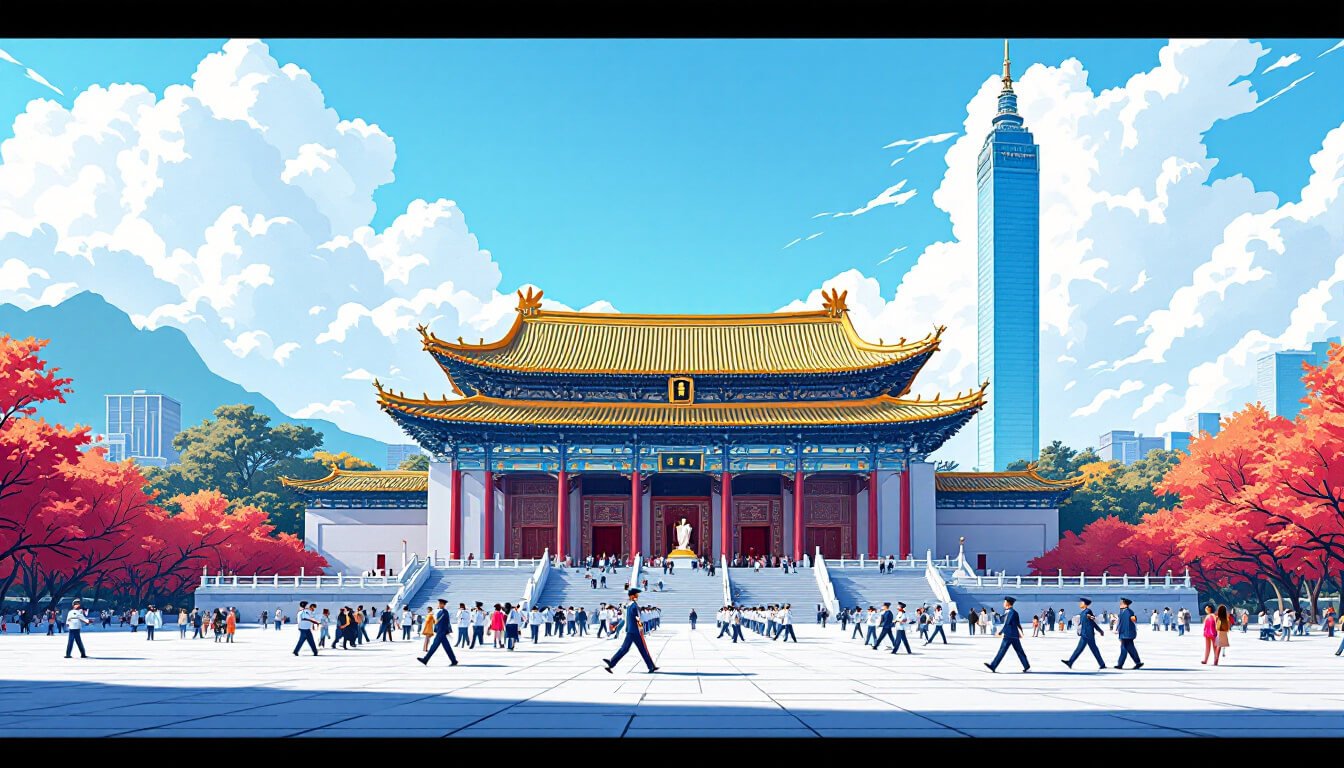
Between Songshan Cultural Park and the Xinyi luxury cluster sits a landmark that most itineraries skip because it feels too obvious. That’s a mistake. The Sun Yat-Sen Memorial Hall (國父紀念館) is one of the great free experiences in Taipei, and if you time it right it’s also one of the most photogenic.
The hall was completed in 1972 to commemorate the founding father of the Republic of China. Architect Wang Da-hong wanted a building that was recognizably Chinese without leaning on the pastiche palace-roof template that a lot of KMT-era public buildings defaulted to. What he produced is a squarish, three-story structure with a distinctive yellow-tiled roof that curves up at the corners without ever pretending to be a Ming palace. The four-meter bronze statue of Sun Yat-Sen sits inside the main hall, and every hour on the hour, five honor guards from Taiwan’s armed forces perform a ceremonial changing-of-the-guard.
The changing ceremony is worth building your afternoon around. Five soldiers in dress white — army, navy, air force rotate — march in perfect synchrony from the door of the hall to the statue and back, an elaborate rifle-spinning routine included. It’s fifteen minutes of choreographed precision that has more in common with a Buckingham Palace changing than anything else in the city. Entry is free. There’s no ticket. Just show up ten minutes before the hour.
The plaza outside the hall is where locals actually use the building. Come here early morning and you’ll see rows of retirees doing tai chi. Come in the evening and there are dance classes, roller skaters, and kids on scooters. The lawn frames Taipei 101 in a way that makes it the single most-Instagrammed vantage point in Taiwan, which is why you’ll see wedding-photography teams staked out at sunset most weekends.
Xinyi Food and Drink: From Din Tai Fung to A Joy
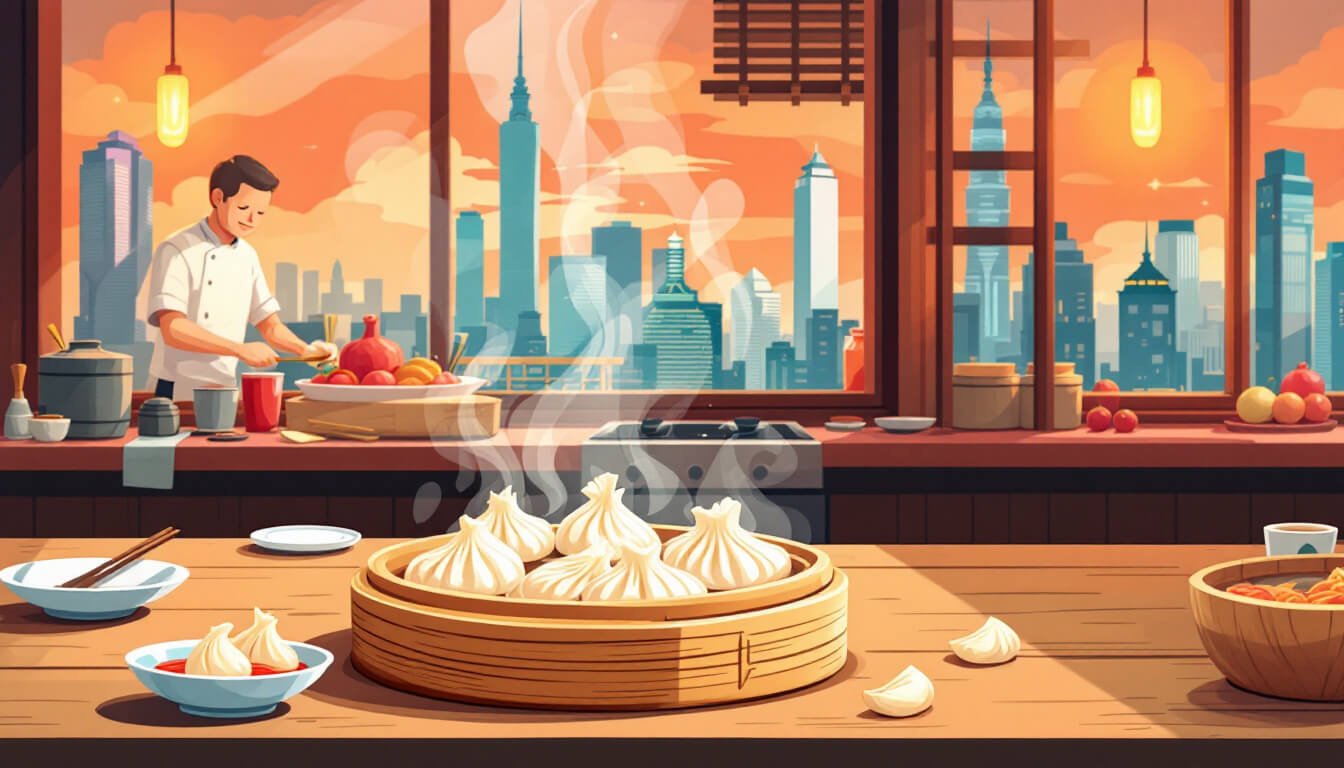
Every food guide to Xinyi will send you to Din Tai Fung, and every guide is right to do so. The Xinyi flagship on Songgao Road is one of three Din Tai Fungs in this district, and while you can eat their xiaolongbao at forty locations worldwide by now, there is a reason people still line up at the original. Order the classic pork xiaolongbao, the shrimp-and-pork wontons in spicy sauce, the drunken chicken. Skip the fried rice unless you have room. Twenty minutes and a couple thousand NTD later, you’ll understand why UNESCO listed Din Tai Fung’s craft as intangible cultural heritage. (They didn’t, but they should have.)
For a different tier entirely, book A Joy months ahead. It’s a three-Michelin-star French restaurant on the 25th floor of the Mandarin Oriental, which technically isn’t Xinyi but is close enough that most guides file it here. Chef Alain Huang cooks with a Taiwanese sourcing philosophy — Penghu octopus, local kohlrabi, wild-caught grouper — plated in a modernist French idiom. It is not cheap. It is also not a tourist trap. Our Taiwan Michelin guide covers the rest of the starred restaurants worth the flight.
For everyday eating, Xinyi’s food strength is actually the office-lunch crowd. Try Bandao Beef Noodle for a proper Taiwanese beef noodle soup that costs less than an Uber ride. Try Chuan Xiang Si for Sichuan mapo tofu. Try any of the basement food courts under the malls (the one under Taipei 101 has a very solid oyster omelet stall). The Xinyi office workforce has forced these places to be good and cheap, because the same people eat lunch here five days a week and they will not tolerate mediocrity for NTD 200.
For coffee, Xinyi is having a moment. Simple Kaffa Sola on the roof of Taipei 101’s neighboring tower is run by Berg Wu, the 2016 World Barista Champion — his beans are consistently among the best in Taiwan. Around the Songshan Cultural Park perimeter you’ll find a handful of newer specialty roasters (Tropo, Ongu, Coffee by U co.) that are quietly stealing customers from the Da’an cafe scene.
For a night cap with a view: the rooftop of ATT 4 FUN, the 20th floor of Le Meridien, or Frank Taipei atop Grand Hyatt. All three deliver the same Taipei 101 skyline shot for slightly different prices. If you want street energy instead of altitude, walk five minutes to Wuxing Street Market where the office crowd unwinds over grilled skewers and bottles of Taiwan Beer.
How to Walk All Three Xinyis in a Day
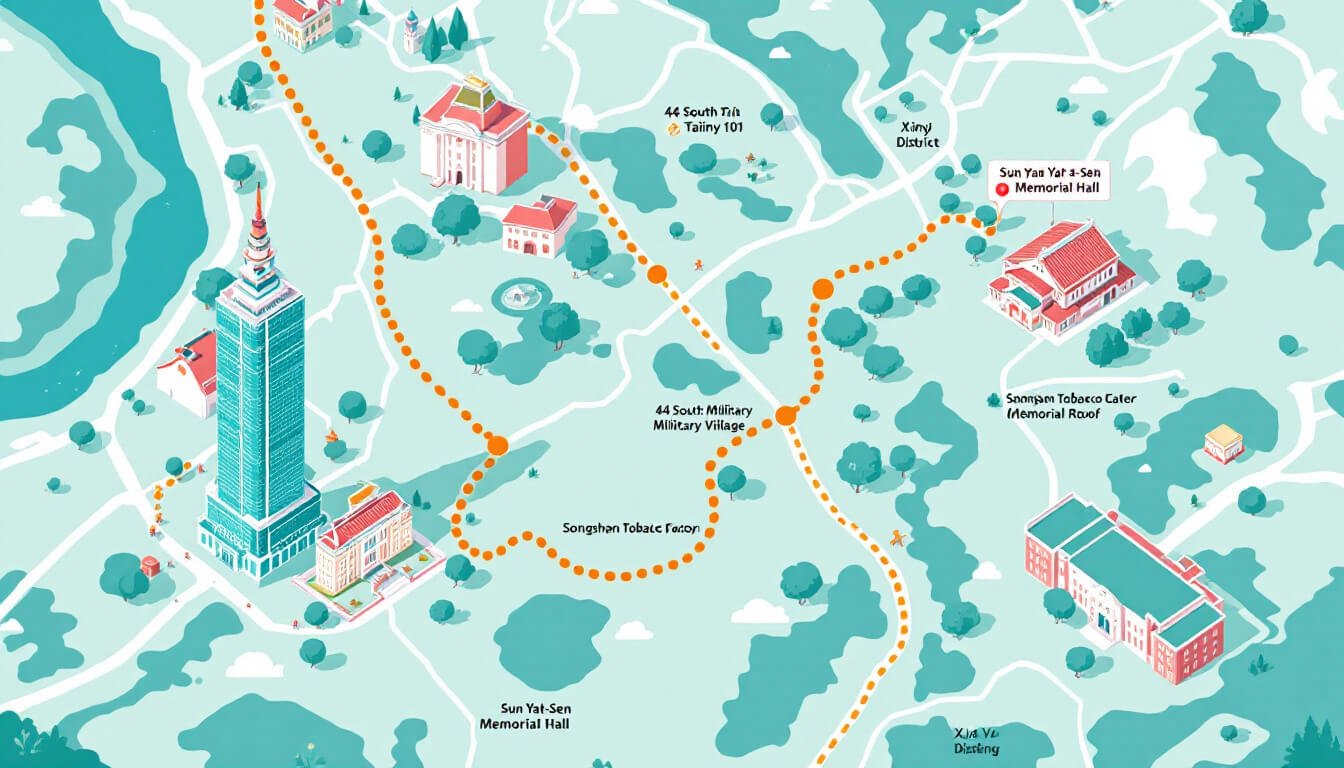
Here’s the route if you want to see all three layers in one push. Total walking time about ninety minutes, plus stops. Half-day pace.
Start at Sun Yat-Sen Memorial Hall MRT (Blue Line, exit 4) in the morning around 9:30. Watch the 10:00 changing of the guard. Wander the plaza. Grab coffee from Simple Kaffa Sola or one of the Songshan Park roasters.
Walk east ten minutes to Songshan Cultural Park. Spend an hour in the Japanese-era buildings. Visit the Not Just Library if you’re a design nerd, otherwise browse the design shops and grab a snack. Cut through the ecological pond area to reach the eastern gate near Taipei Dome.
Walk south along Songzhi Road for fifteen minutes. You’ll pass ATT 4 FUN and cross into the luxury-mall grid. Detour into Bellavita or Shin Kong Mitsukoshi if you want to browse. Otherwise keep going toward Taipei 101.
Lunch at Din Tai Fung Xinyi around 12:30 (or the basement food court under Taipei 101 if you don’t feel like queuing). Post-lunch, take the observation-deck elevator up Taipei 101 for the panoramic view — the whole geography of your day so far will suddenly click into place.
Walk south five minutes to 44 South Military Village. This is the emotional peak of the route. Spend forty minutes in the exhibition halls and courtyards. If it’s a weekend, Simple Market vendors will be set up in the plaza. Take the photograph with Taipei 101 rising over the tiled roofs — this is the one image that captures Xinyi as it actually is.
Loop back to Xiangshan MRT (Red Line, exit 2) to close the loop, or hike Elephant Mountain (Xiangshan) for sunset over the city — the trailhead is a five-minute walk from 44 South. For dinner, come back down to Wuxing Street Market for skewers and Taiwan Beer, or splurge at A Joy if you booked ahead. If you’re planning a longer trip and want to slot Xinyi into a broader itinerary, our complete guide to things to do in Taipei covers what to pair it with on days two through five.
Final Thoughts
Xinyi Taipei is the district that Taipei uses to sell itself to foreign investors and Instagram tourists, but it’s also, quietly, a small master-class in twentieth-century Taiwanese history. Three eras of the island’s story sit within a fifteen-minute walk of each other. The Japanese-industrial Songshan, the KMT-refugee 44 South, and the post-1990s skyscraper grid. Once you know they’re there, you can’t visit any of them in isolation. That’s the entire point of coming here.
Go slow. Skip the checklist. Let the seams show.
Grab a Free Taiwan Sticker!
Drop your email and we’ll send you a limited-edition Taiwan sticker — plus insider access to new merch drops and island vibes.
No spam. Unsubscribe anytime.