Taiwan Personal Seals: Why a Tiny Carved Stamp Still Beats a Signature on Every Important Document

You walk into a Taipei bank to open your first account. You slide your passport across the counter, ready to sign on the dotted line — and the teller smiles politely and asks for your 印章. Your what? Welcome to one of Taiwan’s most enduring cultural quirks: the tiny carved personal seal that, in 2026, still outranks your signature on almost every document that actually matters.

This isn’t ceremonial nostalgia. It’s how bank accounts get opened, marriages get registered, property gets bought, and contracts get signed across the island every single day.

What Exactly Is a 印章?

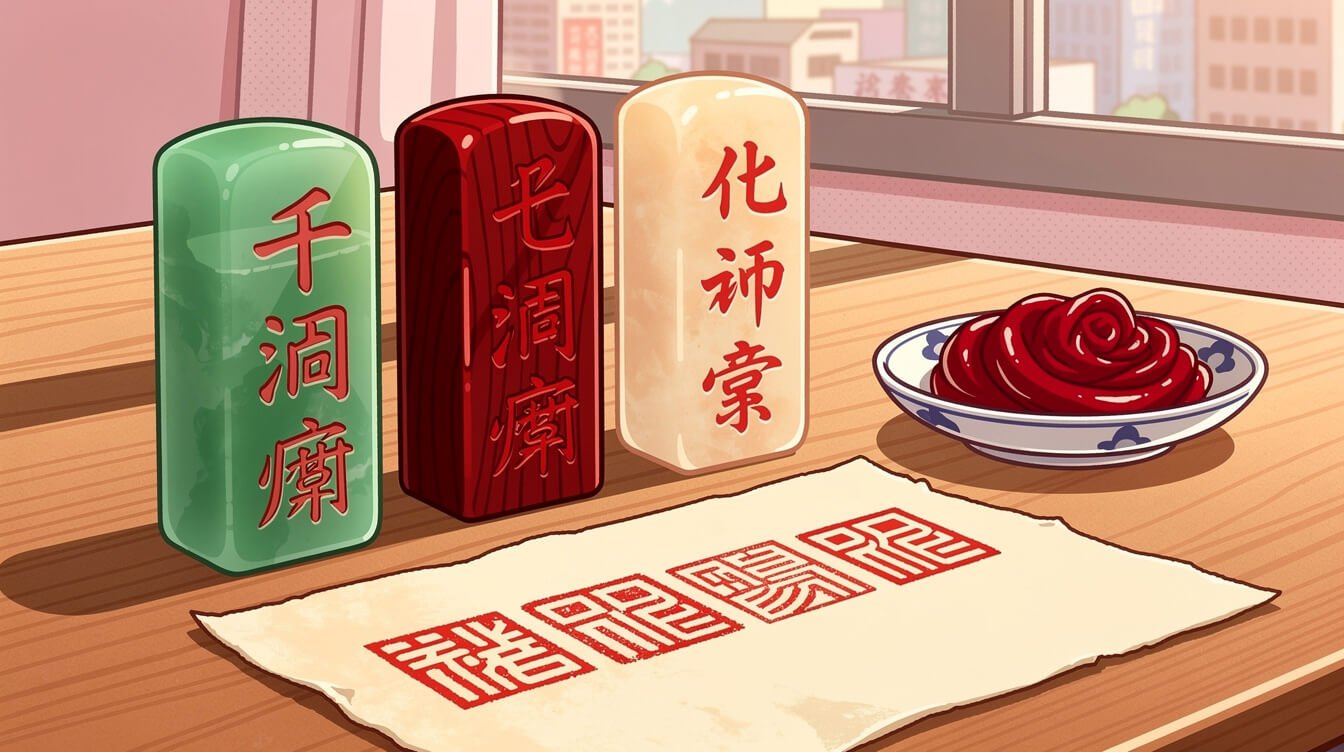
A 印章 (yìnzhāng) — sometimes called a 圖章 (túzhāng) or, in shop signs, a “name chop” — is a small carved cylinder, usually one to two centimeters thick and a few centimeters tall. The carved end bears your name, rendered in mirrored seal script (篆書), and pressing it into a sticky pad of crimson cinnabar paste (印泥) leaves a bold red square impression that functions, legally, exactly like a signature in the West.

The tradition stretches back roughly four thousand years to the Shang dynasty, when bronze seals authenticated imperial decrees. Taiwan inherited the practice, adapted it through Japanese colonial influence (the Japanese call their version a hanko), and never quite let it go.

The Three Seals Every Adult Tends to Own

Most Taiwanese adults end up with at least three:

  • The casual seal (閒章) — used for everyday signing: receiving packages, signing for deliveries, marking personal letters. Anyone can carve one in five minutes from soft wood for under NT$200.
  • The registered seal (印鑑) — the heavyweight. Officially registered at your local household-registration office (戶政事務所), it’s required for property transactions, inheritance paperwork, vehicle transfers, and marriage registration. Lose it, and you’ll spend an afternoon at the office re-registering a new one.
  • The bank seal — a separate seal registered specifically with each bank where you hold accounts. Withdrawals over a certain threshold, account changes, and wire transfers all require the matching impression.

Couples often get matching fūqī yìn (夫妻印) made together as a quiet, slightly romantic milestone — two seals carved from the same block of wood or jade. It’s the kind of low-key cultural detail that doesn’t make the usual gift guides, but says volumes about how Taiwan treats partnership and paperwork as inseparable.

Where the Seals Get Carved

Taiwan still has hundreds of working seal-carving shops, many of them third- or fourth-generation family operations. The densest concentration is along Dihua Street (迪化街) in Taipei’s Datong District — the same historic merchant lane famous for dried goods and Chinese New Year shopping. You’ll spot the shops by the small carved wooden blocks in the windows and the faint, sharp smell of fresh-cut wood drifting onto the sidewalk.

Materials run a wild range: cheap boxwood for everyday casual seals, dense rosewood and buffalo horn for mid-range, hand-carved jade and ox-bone for premium pieces, and rare ivory antiques (no longer legal to make) that show up in family inheritance lots. A simple wooden seal costs about NT$200 to NT$500. A hand-carved jade registered seal from a master craftsman can run NT$5,000 to NT$30,000 — and people genuinely treat them as heirlooms.

Why a Four-Thousand-Year-Old Practice Still Wins in the Digital Age

Taiwan has digital ID cards, Apple Pay everywhere, and one of the world’s fastest 5G networks. So why does the seal survive?

Three reasons. First, the law hasn’t fully caught up — many statutes covering land, marriage, and inheritance still specifically require a registered seal impression. Second, the cultural symbolism is genuinely strong: a seal is something you own physically, store in a hidden drawer at home, and never lend out. It’s identity made tangible in a way no PIN code ever could be. Third, the carving craft itself is part of Taiwan’s living heritage — there are master carvers in their seventies still teaching apprentices, and nobody wants to be the generation that lets it die.

So if you ever find yourself signing a Taiwanese contract and the other side hands you a small carved cylinder and a pad of red ink — don’t sign your name. Press once, firmly, then lift straight up. Welcome to one of Taiwan’s most quietly beautiful traditions, hiding in plain sight.

Love the small, surprising details that make Taiwan, Taiwan? Browse our latest Taiwan-themed merch — every design starts from a cultural moment just like this one.

免費台灣貼紙

免費領取台灣貼紙!

留下您的郵箱,我們將向您發送限量版台灣貼紙——以及搶先了解最新商品發售信息和感受海島風情的機會。.

絕不發送垃圾郵件。隨時可以取消訂閱。.


相關文章

發佈留言

發佈留言必須填寫的電子郵件地址不會公開。 必填欄位標示為 *