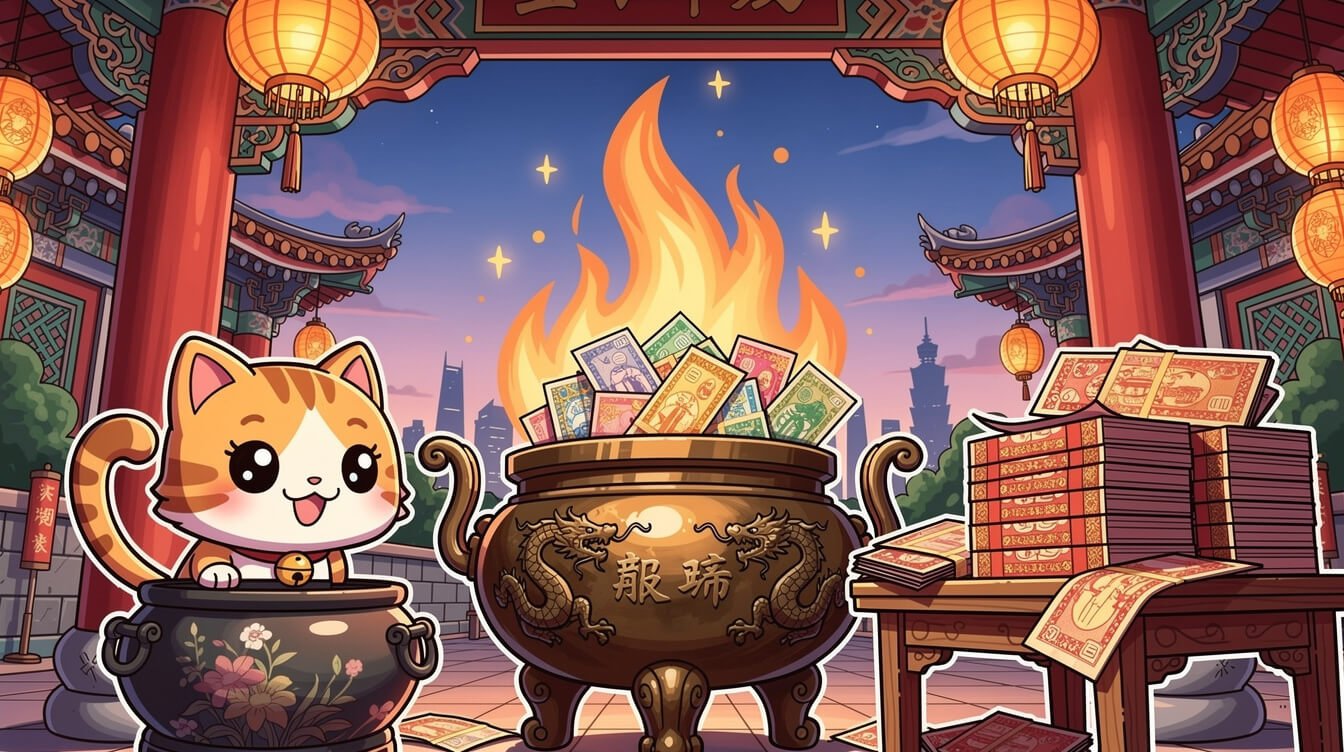
紙錢:為什麼台灣每年八月都要大量焚燒紙錢

你可知道? Every August, Taiwanese temples, curbside metal drums, and family courtyards fill the air with smoke — not from grilled squid or stinky tofu, but from stacks of colorful paper being fed into open flames. It’s 冥紙 (紙錢, zhǐqián), also called ghost money, spirit money, or bank notes for the hereafter. And Taiwan burns an astonishing amount of it.

The number that stops people cold

Estimates published by Taiwan’s Environmental Protection Administration put the annual volume of joss paper burned islandwide at roughly 200,000 metric tons. To picture that: it’s enough paper to fill more than 8,000 shipping containers. And the biggest single week of the year is coming up — the opening of 鬼月 on August 13, when families begin four full weeks of ancestor offerings, roadside feasts, and yes, a whole lot of burning.

What is joss paper, actually?

Joss paper isn’t random scrap. Each sheet is a specific denomination, folded and printed by hand or press to represent currency for the spirit world. The three most common types you’ll see at any temple stall:

  • Gold paper (金紙) — square sheets stamped with a foil square. For gods and major deities.
  • Silver paper (銀紙) — the same idea, but for ancestors and the recently departed.
  • Bank of Hell notes — the Monopoly-money looking ones with the Jade Emperor on the front. Denominations go up to a cheerful ten billion. These are for wandering spirits during Ghost Month.

You’ll also see specialty burnables: paper iPhones, paper Mercedes-Benzes, paper Louis Vuitton bags, and even paper mahjong sets. If a loved one enjoyed it in life, someone in Taiwan makes a paper version of it.

Why burning matters

In Taiwanese folk belief, fire is the transmission line. Burning transforms a physical offering into a spiritual one — the smoke carries the value up to ancestors, gods, or the “good brothers” (好兄弟, the polite term for wandering ghosts). Skipping the ritual isn’t neutral; it’s considered leaving your family in the afterlife financially stranded.

Temples like Longshan in Taipei keep massive bronze furnaces (金爐) burning almost continuously during Ghost Month. In smaller neighborhoods, you’ll spot the cylindrical red metal drums outside 7-Elevens, hardware stores, and family homes.

The modern twist

Rising air-quality concerns have prompted Taipei and Kaohsiung to run “concentrated burning” centers where families can drop off their offerings and have them incinerated cleanly on rotation. Some temples now offer virtual joss-paper burning — you scan a QR code, pay online, and a temple attendant burns it on your behalf. Tradition, upgraded.

要點: If you’re in Taiwan this August and you smell smoke that isn’t coming from a night market — that’s joss paper, and it’s one of the oldest active rituals on the island. Watch respectfully, don’t step over an offering plate on the sidewalk, and if you’re invited to join a family observance, take it as the honor it is.

免費台灣貼紙

免費領取台灣貼紙!

留下您的郵箱,我們將向您發送限量版台灣貼紙——以及搶先了解最新商品發售信息和感受海島風情的機會。.

絕不發送垃圾郵件。隨時可以取消訂閱。.


相關文章

發佈留言

發佈留言必須填寫的電子郵件地址不會公開。 必填欄位標示為 *