How High Is Taipei 101? The Exact Height Plus the Wild Engineering Behind Taiwan’s Iconic Tower
If you’ve ever stood at the foot of Taipei 101 and tilted your head back until your neck hurt, you already know the honest answer: too high to fully process. But the precise number people search for is this — how high is Taipei 101? The tower rises 508 meters (1,667 feet) from street level to the tip of its architectural spire, with 101 floors above ground and 5 below. That made it the tallest building on Earth for six and a half years, the first structure ever to break the half-kilometer mark, and the reason Taiwan punched a permanent hole in the international skyline conversation.
But the height is just the headline. The full story — why it’s 101 stories instead of 100, what’s holding it steady during typhoons, how it briefly took the world title from the Petronas Towers, and what it actually feels like to ride an elevator that climbs 84 floors in 37 seconds — is way wilder than the number on the postcard. Here’s everything you wanted to know about Taipei’s iconic green-glass pagoda in the sky.
The Exact Numbers: How High Is Taipei 101?

Skyscrapers are slippery when it comes to height because there are multiple “right” answers depending on what you’re measuring. For Taipei 101, here are all the official numbers straight from the Council on Tall Buildings and Urban Habitat (CTBUH):
- Architectural top (with spire): 508.0 meters / 1,667 feet
- To the tip (antenna included): 509.2 meters / 1,671 feet
- To the roof: 449.2 meters / 1,474 feet
- Highest occupied floor: 438.0 meters / 1,437 feet
- Floors above ground: 101
- Floors below ground: 5
So when someone asks “how high is Taipei 101?”, the cleanest answer is 508 meters or 1,667 feet — that’s the official architectural height that CTBUH uses to rank buildings against each other globally. When you visit the indoor observatory on the 89th floor, you’re standing 438 meters above Taipei. The outdoor observatory on the 91st floor takes you a few meters higher, where you can actually feel the building gently swaying in the wind.
For a quick comparison: the Eiffel Tower is 330 meters with its antenna, the Statue of Liberty is 93 meters, and the Empire State Building hits 443 meters with its spire. Taipei 101 outpaces all three combined heights of the Statue of Liberty stacked five times over.
Why 101 Floors? The Symbolism Hidden in the Number
The building was originally supposed to be 66 stories. Yes, really. Early planning in 1997 imagined a more modest tower as an anchor for the Xinyi business district. An expat architect on the team pushed for something more ambitious — and when the city granted the license in 2000, the design jumped to its now-famous 101.
The number was deliberate on multiple levels:
- 100 + 1: A nod to perfection that goes one step further — the idea of always pushing one floor beyond what’s expected.
- Xinyi business district: The site sits in the 101 commercial planning zone, so the floor count doubled as an address.
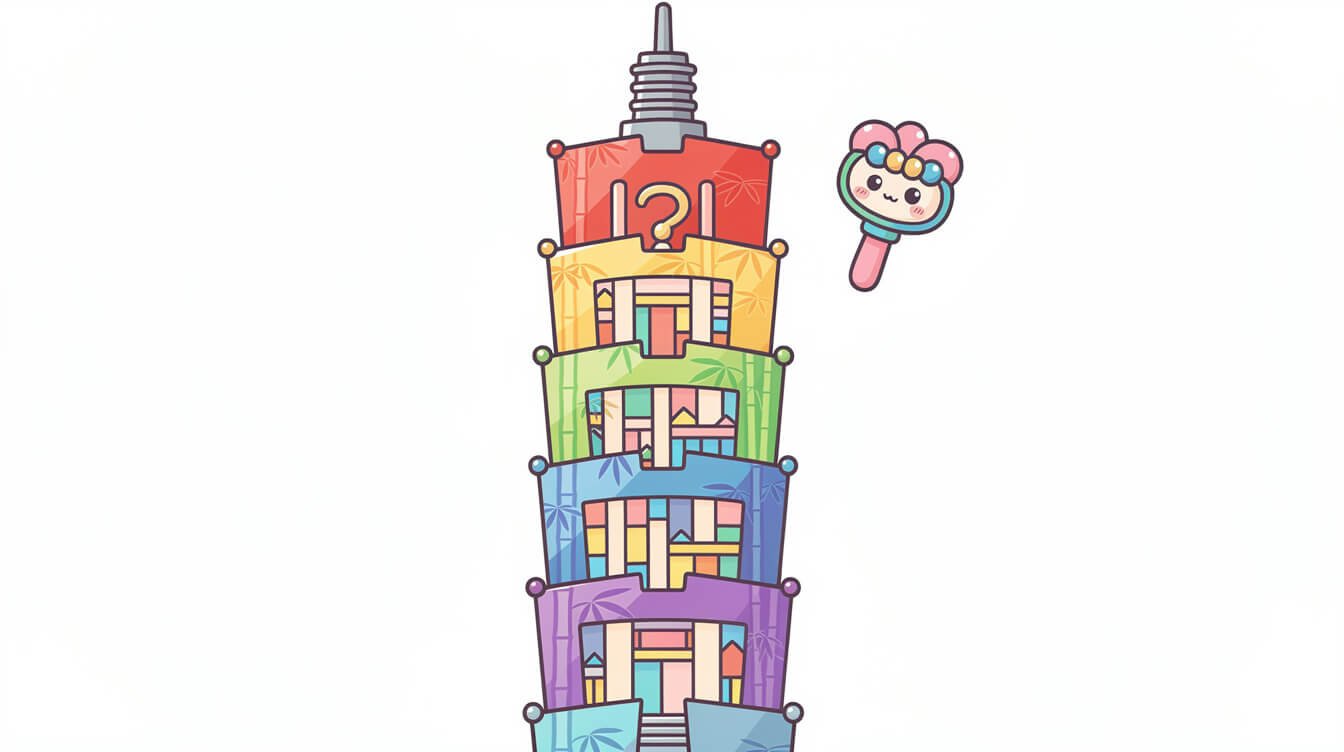
- Asian symbolism: The tower is divided into eight visually distinct segments of eight floors each, and 8 is the luckiest number in Chinese culture (it sounds like the word for prosperity). That tiered design is what gives Taipei 101 its famous bamboo-stalk silhouette — each segment slightly wider than the last, like sections of a hollow bamboo shoot reaching for the sky.
- Ruyi scepters: The decorative emblems on the building’s facade are stylized ruyi — traditional Chinese symbols of good fortune. The adjoining shopping mall features the world’s largest ruyi as an exterior feature.
So Taipei 101 isn’t just tall — it’s a piece of architectural calligraphy. Every design choice points back to traditional East Asian aesthetics translated into modern steel-and-glass form. The lead architects, C.Y. Lee and C.P. Wang, deliberately fused postmodernism with neo-futurism to make the tower feel both ancient and ahead of its time. If you’re already deep into the country’s design heritage, our complete guide to Taiwan culture unpacks how this aesthetic shows up everywhere from temples to tea houses.
The Engineering Marvel That Holds Taipei 101 Steady
Here’s the wild part: Taipei sits in one of the most seismically active corners of the planet. The building is located just 200 meters (660 feet) from a major fault line, and Taiwan is hammered by an average of three to four typhoons every summer. Building a half-kilometer-tall skyscraper here should be borderline insane. The engineering response is one of the most fascinating in the world.
The 660-Ton Golden Ball
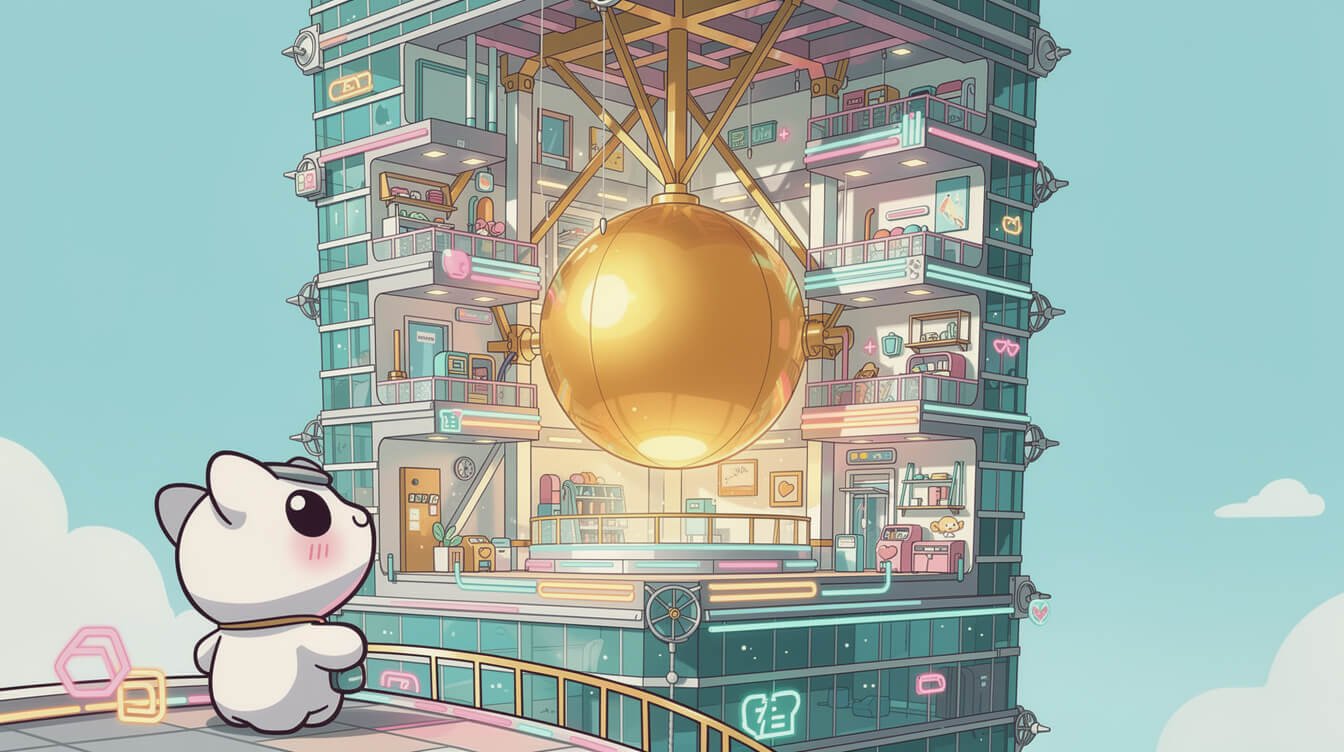
Suspended between the 87th and 92nd floors hangs an enormous golden steel sphere — a tuned mass damper weighing 660 metric tons and measuring nearly 6 meters (18 feet) across. Designed by Canadian firm Motioneering, it cost NT$132 million (about US$4 million) and is the largest publicly visible damper in the world. When wind or earthquakes push the tower one direction, the damper swings the opposite direction, canceling out up to 40% of the building’s sway.
You can actually visit it. The damper has its own observation level with a cute cartoon mascot called Damper Baby that Taiwanese visitors love. It’s the only major damper of its kind that the public can see — most are hidden in mechanical floors.
Designed to Outlast Typhoons
The structural engineer, Evergreen Consulting Engineering (with Thornton Tomasetti consulting), designed Taipei 101 to withstand gale winds of 60 meters per second — that’s 216 km/h or 134 mph. The tower is rated for the strongest earthquake in a 2,500-year cycle. Outrigger trusses at every eight-floor interval connect the building’s central core to its exterior columns, distributing seismic and wind loads across the whole structure rather than letting them concentrate at any single weak point.
A Foundation Driven Into Bedrock
Beneath the tower, 380 concrete piles are driven 80 meters (262 feet) into the ground, with the deepest piles reaching 30 meters into solid bedrock. Each pile is 1.5 meters in diameter and can bear up to 1,320 short tons of load. The cost to build all this came in at NT$58 billion (about US$1.9 billion) over six years of construction from 1999 to 2004.
The result: Taipei 101 has survived multiple major earthquakes and dozens of typhoons without structural damage. During the 2002 earthquake mid-construction, two cranes fell from the 56th floor — but the tower itself was fine. That’s not luck. That’s a building designed for the worst day in two and a half millennia.
How Taipei 101 Compares to the World’s Tallest Buildings

From its opening on December 31, 2004, Taipei 101 was officially the tallest building in the world. It held that record for six years and 70 days — until Dubai’s Burj Khalifa opened on January 4, 2010, at a comfortable 828 meters (2,717 feet). Today, Taipei 101 ranks as the 11th tallest building in the world as of 2026, according to CTBUH’s official rankings.
Here’s how it stacks up against the global heavyweights:
- Burj Khalifa (Dubai): 828 m / 2,717 ft — 63% taller than Taipei 101
- Merdeka 118 (Kuala Lumpur): 678.9 m / 2,227 ft
- Shanghai Tower: 632 m / 2,073 ft
- Taipei 101: 508 m / 1,667 ft
- One World Trade Center (NYC): 541 m / 1,776 ft to spire
- Petronas Towers (Kuala Lumpur): 451.9 m / 1,483 ft — beaten by Taipei 101 by 57.3 m
- Willis Tower (Chicago): 442 m / 1,450 ft to roof
- Empire State Building (NYC): 381 m / 1,250 ft to roof
Taipei 101 was also the first building in history to break the half-kilometer mark, beating the previous record (the Petronas Towers) by 57.3 meters — a jump bigger than the height of the Statue of Liberty’s pedestal. That achievement is part of why the Council on Tall Buildings and Urban Habitat named Taipei 101 one of the 50 most influential skyscrapers in the world in 2019.
If a giant kawaii silhouette of the tower belongs on your wall (or your chest), our Taiwan-themed apparel and design collection at Taiwan Merch has dozens of Taipei landmark tees and prints that pay tribute to the skyline — perfect for travelers who want to wear their love for the island home.
What’s Actually Inside Taipei 101: Observatory, Mall, and the Fastest Elevators in History
The tower isn’t just for looking at from the outside. It’s a working, breathing piece of Taipei’s commercial life — and one of the most visited tourist destinations in the country.
The Observatories: 89th Floor and 91st Floor
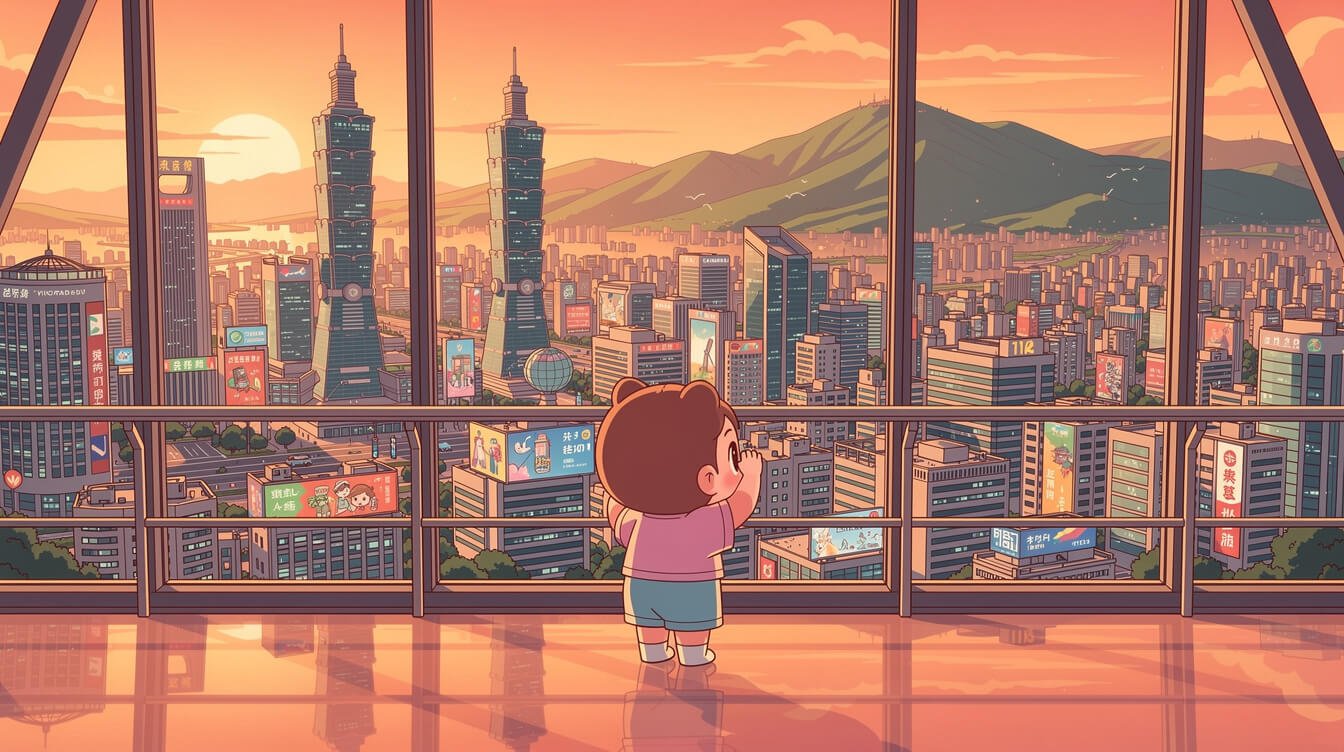
Riding to the indoor observatory on the 89th floor (449 meters / 1,474 feet) is the standard tourist experience. Floor-to-ceiling windows wrap the entire level, giving you 360-degree views of Taipei’s basin, the surrounding mountains, and (on a clear day) all the way to the coast. Audio guides walk you through what you’re looking at in over a dozen languages.
For an extra thrill, head up two more floors to the outdoor observatory on the 91st floor. This is the open-air deck — only accessible when weather allows — where you can feel the wind, hear the city below, and (depending on the day) actually feel the building swaying ever so slightly under your feet. That swaying is intentional. A rigid skyscraper would crack; Taipei 101 was designed to move.
The 37-Second Elevator Ride
Getting to the observatory is half the experience. Toshiba built 61 elevators for the tower, and at opening they held the world record as the fastest passenger elevators ever built. The express observatory elevator runs from the 5th floor to the 89th floor in 37 seconds, hitting top speeds of 60.6 km/h (37.7 mph). That’s faster than most cars drive in the city. The cabins are pressurized so your ears don’t pop the way they would in an airplane. Taipei 101 held the fastest elevator title for 12 straight years.
The Taipei 101 Mall
Skirting the base of the tower is a six-story luxury shopping mall — a destination in its own right that draws millions of visitors yearly. Brands include the international luxury heavyweights (Louis Vuitton, Chanel, Hermès, Gucci) alongside Taiwanese designers, premium food halls, and the famously good Din Tai Fung dumpling restaurant on the basement level. The mall’s exterior features the world’s largest ruyi scepter design — that golden, S-shaped emblem you might have noticed wrapping the side of the building.
Want the wider story of what to do in the neighborhood? Our guide to things to do in Taipei maps out how Taipei 101 fits into a full day in the Xinyi District, including the night markets, hiking trails, and bars within walking distance.
From World’s Tallest Tower to Cultural Icon: Why Taipei 101 Still Matters

Taipei 101 lost the “world’s tallest” crown in 2010. So why does it still feel so iconic? Because being the tallest was never the point. The tower’s real legacy is what it did for Taiwan’s place in the global imagination.
When Taipei 101 opened on December 31, 2004, it was the first building anywhere to crack 500 meters — and the first time East Asia took the world’s-tallest title from a Western architectural icon (the Sears/Willis Tower had passed the crown around within the Petronas Towers’ brief tenure, but Taipei 101 stretched the bar much higher). For Taiwan, a country whose statehood is contested by its neighbor across the strait, putting the tallest structure on Earth on a Taipei skyline was a quiet act of national assertion.
It’s also become Taipei’s emotional touchpoint. The annual New Year’s Eve fireworks show wrapped around the tower draws an estimated million spectators to the surrounding plaza and is broadcast live to millions more globally — one of the most photographed New Year displays anywhere in the world. The tower has displayed Einstein’s famous E=mc² formula in lights for the 100th anniversary of relativity, a pink ribbon for breast cancer awareness, condolence messages for national tragedies, and countless other civic moments. It’s not just a building. It’s how Taipei talks to itself.
The tower has also drawn its share of dramatic moments. French urban climber Alain Robert scaled the pinnacle in 2004. Austrian BASE jumper Felix Baumgartner illegally parachuted off the 91st floor in 2007 (and got himself banned from Taiwan). And just months ago, on January 25, 2026, American free-solo legend Alex Honnold completed the tallest urban free-solo climb in history, summiting Taipei 101 in 1 hour, 31 minutes, and 43 seconds — an event streamed live on Netflix as Skyscraper Live. The tower keeps writing new chapters into its own myth.
In 2011, Taipei 101 also became the world’s tallest LEED Platinum-certified green building, with energy-efficient retrofits saving 14.4 million kilowatt-hours of electricity annually. Eight years later, CTBUH ranked it among the 50 most influential skyscrapers ever built.

Wear Your Love for Taiwan
If Taipei 101 made you fall harder for the island, we’ve got you covered. Browse our curated collection of Taiwan-themed tees, accessories, and home goods — designed with the same playful, pop-culture energy that makes Taiwan unforgettable.
Frequently Asked Questions About Taipei 101’s Height
How high is Taipei 101 in meters?
Taipei 101 stands at 508 meters measured to its architectural top (including the spire), or 509.2 meters to the very tip of its antenna. Roof height is 449.2 meters, and the highest occupied floor — the 91st-floor outdoor observatory — sits at 438 meters above ground.
How high is Taipei 101 in feet?
Taipei 101 is 1,667 feet tall to its architectural top, or 1,671 feet to the tip of the antenna. The roof reaches 1,474 feet, and the 91st-floor observatory sits 1,437 feet above street level.
How many floors does Taipei 101 have?
101 floors above ground, plus 5 basement levels. The tower is visually divided into eight tiered segments of eight floors each — a deliberate nod to the number 8, which is considered the luckiest number in Chinese culture.
Is Taipei 101 the tallest building in the world?
Not anymore. Taipei 101 was the tallest building in the world from December 31, 2004, until January 4, 2010, when it was surpassed by the Burj Khalifa in Dubai (828 meters / 2,717 feet). As of 2026, Taipei 101 ranks as the 11th tallest building in the world and is still the tallest building in Taiwan.
How long did it take to build Taipei 101?
Construction began on January 31, 1999, and the tower officially opened on December 31, 2004 — a total of about six years, including a brief pause after the 2002 earthquake that struck Taiwan mid-construction. Total cost: NT$58 billion (around US$1.9 billion).
Can you visit the top of Taipei 101?
Yes. The indoor observatory on the 89th floor is open year-round, and the outdoor observatory on the 91st floor opens whenever weather conditions permit. The express elevator from the 5th floor reaches the 89th floor in just 37 seconds — among the fastest elevators ever built.
What’s inside Taipei 101 besides the observatory?
The tower houses offices, restaurants, and the famous 660-ton tuned mass damper on display between the 87th and 92nd floors. The base is connected to a six-story luxury shopping mall with brands like Louis Vuitton and Hermès, a basement-level Din Tai Fung, and the world’s largest exterior ruyi scepter design.
Final Thoughts: The Real Height of Taipei 101
So how high is Taipei 101? In numbers: 508 meters, 1,667 feet, 101 floors. In meaning: a postmodern bamboo stalk that survived 25 years of typhoons and quakes, broke the half-kilometer skyscraper barrier for the first time in human history, and gave a small island nation a permanent silhouette on the world’s skyline. It held the world title for six years, taught engineers how to suspend a 660-ton golden ball inside a tower, and still lights up the Taipei night sky every New Year’s Eve in a fireworks display millions of people gather to watch.
Numbers tell you it’s the 11th-tallest building in the world. Standing under it tells you something else — that the height you measure isn’t always the height that matters. Visit it once, and Taipei 101 stops being a record on a chart. It becomes the place you point to when someone asks where Taiwan is.

Grab a Free Taiwan Sticker!
Drop your email and we’ll send you a limited-edition Taiwan sticker — plus insider access to new merch drops and island vibes.
No spam. Unsubscribe anytime.